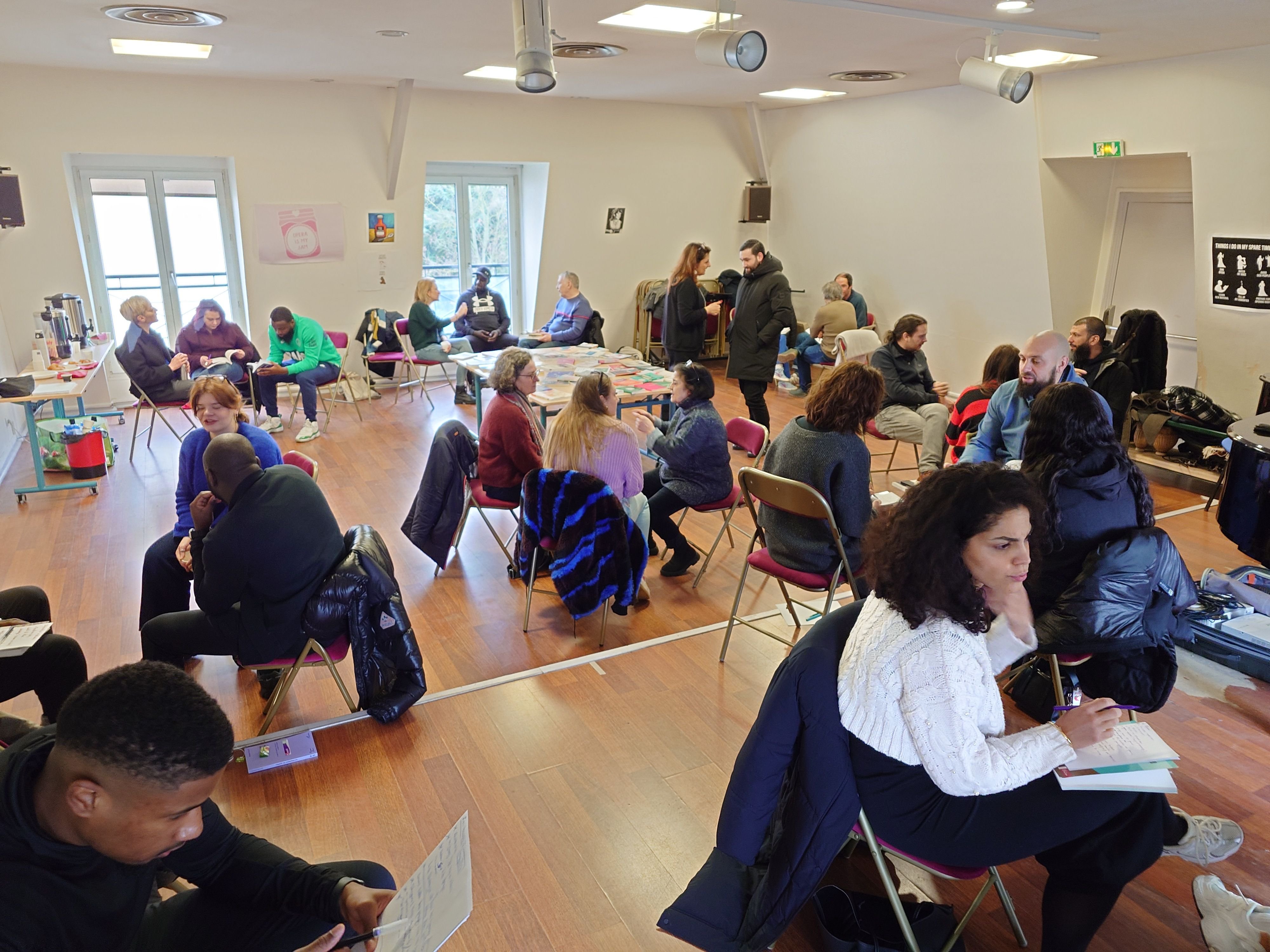
In many cities, culture teams and youth teams have to work together even though their professional cultures differ profoundly, and the service delivered to residents suffers from it. Fontenay-sous-Bois chose to invest in addressing this problem. Here I tell the story of the programme I led there, its method and its effects.
Two professional cultures, one public service
In any city, culture teams and youth teams know they have to work together, and most of them want to. But they come from very different professional cultures, with occupations that were built separately, each with its own training paths, references and remits, and since this difference has rarely been worked on as such, they cooperate less well than they would like. The consequences are concrete: projects that never happen or happen badly, duplicated efforts, departments that each communicate on their own, pricing inconsistencies, with the same activity free in one department and paid in another, and reception practices that vary from one venue to the next. For residents, and for young people first of all, the public offer becomes unreadable, and the sense of incoherence they feel is entirely justified. This is not about individuals, everyone does their best; it comes from organisations and professional histories that no one has ever worked through together.
There is nothing specific to Fontenay-sous-Bois in this observation, and the same could be made in a great many cities. This is the very concrete problem that Carole Ziem, director of cultural affairs of Fontenay-sous-Bois, brought to me in 2024. The training-action programme I describe here was not the starting point, it was the answer, tailor-made with her and with Brian Meleiro, head of the youth department. A city that invests in such work does not do it for its own pleasure: it is addressing an obstacle that directly affects the quality of the service delivered to its residents.
Two departments working for the same young people
In Fontenay-sous-Bois, the two departments had analysed their needs together: more connections between the teams, a shared language, a common culture about youth and its practices, digital practices in particular. The budgetary constraint, growing tighter, also made pooling resources a necessity, and the elected representatives of the two delegations supported the programme, which they came to open in person, together with the city’s general management, at the first session. I already knew this territory, having run travelling night screenings there with the Kosmos cinema.
We called the programme a “training-action”, because the substantive issues would be addressed through shared actions, in a mutual enrichment of skills, and always in touch with the reality of the territory. Five collective intelligence sessions were scheduled, on five Thursday mornings, each on a different theme and in a different venue:
- on 14 November 2024, at the Intergé, on cross-definitions of youth and culture;
- on 23 January 2025, at the Guy Dinoird conservatory, on reception;
- on 13 February 2025, at the media library, on projects with young people;
- on 20 March 2025, at the Jean-François Voguet theatre, on communication;
- on 10 April 2025, at the Gérard Philipe cultural centre, on the pedagogy of free access.
Moving, in every sense of the word
These venues are the daily professional environment of some, and remain, for the others, buildings one walks past without entering. Entering them together, being welcomed there by colleagues, was already the subject of the training. And each time, I set up a specific scenography, designed for that venue and for what was going to be worked on there: a large table covered with books on culture and youth as participants arrived, a mobile library we carried from session to session, or a large floor left empty for a map to be drawn on it. In this way people inhabited places of their everyday life in a singular way, and this sidestep stays in the memory. Colleagues can refer back to it later, as to a shared experience that happened somewhere, on a precise day.
I had set out another principle from the start, central to my method: between each session, we prepared the next one with the two management teams, in a working meeting, based on what had actually happened. We had a preliminary programme, of course, co-designed as early as summer 2024. But what happens in a session is often not what was planned, and that is generally good news, because when people take the work where it was not expected to go, it means they have made the project their own. I also adapted during the sessions themselves. On the second morning, for instance, I let a sequence planned for fifteen minutes run for twenty-five, because the participants still had things to say to each other, and I narrowed the following workshop down to two themes instead of three, to go deeper rather than cover more.
Learning requires a secure environment. Olivier Houdé shows in “Apprendre à résister” (2014) that learning means fighting against one’s own automatic patterns of thought, and that a brain that feels judged switches into protection mode instead of learning. So a framework is not a collection of prohibitions, it is a device that authorizes, and the people in charge are its guarantors. I have devoted an article to this notion, The framework that authorizes.
Finally, throughout the programme, the productions of the sessions (maps, workshop sheets, felt-pen summaries, audio recordings of the presentations) were photographed and put online by the participants, from their own phones, on a very simple digital contribution space. These traces created links from one session to the next, and one could see in them, in passing, how digital tools can serve cooperation, including with young people.
The invisible border, drawn on the floor
The first session, at the Intergé, began with quick warm-up exercises: a “sit-stand” game where everyone stands up or stays seated according to their answers to slightly provocative questions (who has TikTok on their phone, who thinks social media are dangerous), then rotating pairs in which a culture staff member and a youth staff member give each other, in two minutes each, their definition of youth, then of culture. Ten minutes of individual speech, and everyone had already experienced the other’s vision.
I then offered some substantive input. Criticism of youth is as old as writing itself, Salomé Saqué gathers its traces in “Sois jeune et tais-toi” (2023), from Hesiod to Socrates, and reading this continuity teaches us more about societies than about their young people. Nor is youth a homogeneous category: Camille Peugny establishes in “Pour une politique de la jeunesse” (2022) that cultural tastes owe far more to social backgrounds than to age, which makes the reflex of “young people will love this” sociologically absurd. I also retraced the history of the French Ministry of Culture and distinguished cultural democratisation, a top-down approach, from cultural democracy, founded on exchange and mutual enrichment, drawing on cultural rights as formalised in the 2007 Fribourg Declaration.
Then came the most concrete moment: the collective making, on the floor, of a map of Fontenay-sous-Bois. Everyone, with felt pens and sheets of paper, laid down the existing places and the dreamed-of places, then the actors, then the young people. During the workshop, a participant suggested changing the method and dealing with the places one by one, discussing directly the actors and the young people associated with each, and we followed her. On this map, a border drew itself, one that everyone knew without ever having laid it out together. A participant put it simply: “there is an invisible border”, the cultural venues are in the Old Fontenay, the sports facilities in the Val de Fontenay. The participants then went through the places one by one: the Kosmos, where teenagers mostly come within a school setting, despite the Pass Culture; the media library, whose elitist image, “the famous shush”, persists despite all efforts, while its teams now think of it as a third place, neither home nor work; the conservatory, considered too far away for the residents of the Val de Fontenay, despite the special music classes thanks to which families from the Joliot-Curie area were able to enter it when they had thought it out of reach.
Nine chairs for twenty-seven people
The second session, at the conservatory, was about reception. To experience it before talking about it, I had nine chairs set out in the room, for twenty-seven participants. The instruction: the people seated welcome, the people standing get welcomed, and we rotate, so that everyone experiences both postures. Within twenty minutes, very different situations had appeared: welcoming a single person, welcoming a group, waiting to welcome with no one coming; and symmetrically, being welcomed individually, being merged into a group, or waiting in vain for someone to take an interest in you. Some chose deliberately abrupt forms of welcome (“I can’t help you”), and from there deeper questions arose about the relationship to the other. A participant noticed that the closeness of the chairs made it possible to hear the neighbouring exchanges, and that everyone was thus enriched by a collective listening.
The work continued in subgroups, on the qualities needed to welcome and then on the operational conditions of good reception, with a final presentation recorded as a podcast. What comes out of it is that reception is a profession in its own right, which requires demanding interpersonal skills, technical competence and a culture of team solidarity. One testimony marked the group: a staff member insulted by a user recounts keeping her calm while “a colleague took over”. No one should face aggression alone, and that kind of solidarity is built by knowing each other.
Guides written by the staff themselves
For the third and fourth sessions, at the media library and then at the Jean-François Voguet theatre, I shifted the centre of gravity. Rather than passing on my methods, I put the staff in the position of writing their own, each from the capacities that are theirs, and of exercising them in front of their colleagues. In mixed trios first, then in teams, they wrote guides: how to survey young people, how to build projects with them, how to communicate towards them. These guides are part of the summary document handed over to the city, and they can be reused well beyond the training.
From one guide to the next, the same principles recur: go towards young people rather than waiting for them to come; hold to the principle of the speaker’s rationality, that is, start from the idea that every line of reasoning is rational for the person expressing it, even when one disagrees; let young people set the objectives, the means and the purpose of projects, the professional becoming a resource person rather than a decision-maker. The staff themselves invoked Jacques Rancière’s “The Ignorant Schoolmaster” (1987) to describe this stance, and I was not the one who had prompted it. They also shared their successes: two years of manga acquisitions chosen with young people at the media library, an inter-neighbourhood musical theatre festival whose horizon is a trip to Broadway, podcasts about occupations made during middle-school work placements, a film club programmed by nine high-school students at the Kosmos, a music springboard contest whose jury is made up of young people.
We began the session on communication with a clarification, between communication, which aims at the wide circulation of information, and mediation, which takes place in direct address, in the moment. The shared diagnosis pulled no punches: “we toss out a few flyers and wait”, as one participant summed it up, in a society where young people are saturated with information. Youth workers keep in touch on Snapchat and WhatsApp, the theatre relies on adult ambassadors, and young relays are missing everywhere, whereas, as I recalled that morning, a peer recommendation carries about ten times more weight than direct information. The four guides produced during this session cover strategies, media, joint projects and the involvement of young people in communication itself.
Free or paid, a debate finally shared
For the last working session, at the Gérard Philipe cultural centre, we had chosen a divisive subject: free access. I opened with an input on the symbolic value of cultural practices, which is not to be confused with their price: a practice is worth what a young person builds of themselves in it and the bonds that are woven there, and this fully applies to digital practices, which must be recognised as cultural practices in their own right.
In the debate that followed, the departments laid out positions established long ago, but never put on the table together. The media library has practised universal free access since the city voted it in 2017; the youth department defends free access as a gateway to cultural practices; the conservatory applies income-based family rates, with a first bracket of around forty euros a year for an actual cost of about three thousand euros per pupil; the theatre offers free workshops linked to attending performances. These logics, each of them well-founded, lead to inconsistencies that staff experience daily: young people sometimes have to pay to enter the theatre within the very framework of an inter-departmental project. And behind the pricing question, another one appeared, that of families’ cultural education. A youth worker testified to it bluntly: “when I go to a museum, a work of art does nothing to me”, for want of having been educated for it.
This debate joined a project already under way, the harmonisation of pricing across sectors on which the deputy general management is working, with the systematic application of income-based family rates, a solidarity rate and very favourable rates for people under twenty-five, and the exchanges of that morning fed into it. This is the kind of effect I expect from such a programme: that the local authority gives itself the means to decide in full knowledge of the facts, instead of expecting the facilitator to settle the matter.
A restitution carried by the staff themselves
The programme had been opened by the two elected representatives and the city’s general management; it was brought full circle in front of these same people. On 26 June 2025, in a sixth venue, the municipal youth service, we organised the restitution, prepared, like every session, in a working meeting with the two management teams. During the first hour and a half, the staff, in small groups of three or four, took hold of the written summary of the programme, printed for the occasion, and each built a three-minute presentation on one of the eight themes crossed during the year: youth, culture, the territory, reception, projects, communication, value, free access. Then, in front of the elected representatives and the general management, they were the ones who presented the work, in eight presentations followed by a time of exchange, of which I took live notes, projected on screen. This device aimed at one simple thing: that the elected representatives hear the proposals and reflections of the staff, including those who never speak in public, and preparing in small groups makes this speaking-up possible. It is the framework that authorizes, put into action one last time.
The city keeps two deliverables from this year of work. A summary document on the programme, the very one that served as the basis for the restitution. And a complete document of nearly one hundred and eighty pages, containing the accounts of the sessions, the guides written by the staff, the facilitation methods described in detail so that they can be done again, the bibliography of the small mobile library, and a large quantity of directly usable ideas. A first follow-up meeting was also scheduled for the autumn, to take stock of the joint projects under way.
Colleagues who now dare to walk through the door
Not everything is resolved, of course. The invisible border still exists in the city’s geography, the harmonisation of pricing is a work in progress, and mobilising young people remains a daily task. But something has been set in motion. People who used to work a few hundred metres from each other now know each other, know each other’s first names, know who does what and where, and dare to walk through the door of a neighbouring venue. This may look like details. In fact, it matters, because no joint project holds without these elementary bonds of trust.
The methods experienced during these mornings, sensitive mapping, the sit-stand game, rotating pairs, the collective writing of guides, can moreover be reused by the staff with young people themselves. This was an intention set out from the start: what we produce mirrors the way we produce it. This is how I conceive of working on a city’s cultural and youth policy: creative and joyful, and sowing over time, because it rests on strong experiences, lived in common by the people who carry the public service. I have detailed this approach in the article "Culture, youth and digital : designing new modalities for cultural and educational projects.


