From 2017 to 2024, I worked alongside the cultural affairs department of Les Lilas on youth, mediation and digital practices. Workshops, training sessions, a video platform, business tools, a “mediation compass”: all these actions were held together by a single logic, a collective construction carried out with the city’s staff and inhabitants, to root cultural policy in its territory through digital tools, until the teams became autonomous.
A meeting in 2016, then two years of conversations before acting
I met Isabelle Altounian, director of cultural affairs of the city of Les Lilas, in 2016, during a training session of the Observatoire des politiques culturelles where I was a speaker. She wanted to work on youth and digital technology, and she reached out to me. We did not set up a project right away. For nearly two years, we met regularly to talk about the issues at stake, the teams, the municipal cinema, young people’s practices. This long phase of elaboration, with no showcase project to display, is what later allowed the actions to follow one another with great fluidity.
In 2018, Isabelle Altounian included this work in the cultural cooperation agreement between the city and the department of Seine-Saint-Denis, in the form of a project on digital practices, image education and the role of the municipal cinema, co-financed by the city and the department, which she requested again and developed further every year. Most of the actions described below took place within this framework. My position was always twofold: on the inside, as an artist experimenting with the teams, and on the outside, as an advisor helping them to step back. Each artistic action was also a shared experiment, from which the city’s teams drew methods, until they could take them over without me. And it is this overall logic, more than a list of activities, that the department supported by renewing the project year after year.
The cinema lobby becomes a workshop
Fieldwork had actually begun before the agreement. In December 2017, in the Sentes neighbourhood, I led a collaborative photographic storytelling of a neighbourhood festival. We then worked at the Garde-Chasse theatre and cinema. During the autumn 2018 school holidays, in a new format of the “Paroles d’ados” programme, teenagers made some twenty cut-paper animated films, then prepared and presented a public screening. On 27 February 2019, for the « Make a film with your mobile phone » day, we turned the cinema lobby into a continuously open workshop. About a hundred people, children from the leisure centre, families, teenagers, adults who came on their own, made 41 animated films over the day, and most of the participants, who did not know the venue, discovered it through the workshop. These animated cinema workshops later became a regular event at the cinema, and some of the films, such as “Vivement les vacances”, can be seen on the city’s video platform.
I came with my own equipment and mediation devices, but never alone: city staff co-hosted every time, the cinema’s public relations officer, the projectionist, youth workers. These actions were therefore, at the same time, moments of awareness-raising and training in real conditions.
“Turned upside down”: the Lil’Art creators make a collective film
In 2019, the Lil’Art event, which brings together every year around 130 creators in visual arts, arts and crafts and applied arts, had “Sens dessus dessous” (“Turned upside down”) as its theme. I proposed that the creators collectively make a film based on their works. The shooting took place on 11 May 2019 at the Anglemont cultural centre, and the film, « Turned upside down », was shown during Lil’Art in two forms: an immersive video mapping installation at the heart of the theatre, and a screening in the covered market. The film also exists in its own right, and it went on circulating after the event. To organise this collective creation, I had built myself a small business tool to keep track of participants and works.
In the schools and with excluded middle-schoolers, the teams take over
From the 2019-2020 season onwards, the work extended to the after-school programme. On the theme of incivilities, chosen by the after-school service, I led “drawn cinema” workshops in the city’s schools, during after-school time; I had been to seven of the nine schools when the lockdown interrupted the tour. In parallel, within the ACTE programme, temporarily excluded middle-school students made films at the Garde-Chasse cinema. I trained the supervising staff on 8 October 2019, my team accompanied the first three sessions, then the cinema’s young audiences officer ran the following ones on her own. Supported experimentation was becoming a practice carried out in-house.
Lockdown: collective films at a distance and a travelling projection
During the March 2020 lockdown, we moved creation to a distance. I recorded audio tutorials for making sequence-shot films and for doing video activities with your children, and two calls for films were launched, one across the Est Ensemble territory with “Courts intérieurs”, in response to which 37 films were sent in, the other by the cinema, addressed to families. In September 2020, for the European Heritage Days, we organised a travelling projection workshop with the association Un Lieu Pour Respirer. Over several evenings, inhabitants scouted the locations, chose the films and invented their own projection route through the alleys and courtyards of the neighbourhood. Here again, a mediator from the city accompanied every step, because none of these actions was designed as an isolated service.
A sovereign video platform: La fabrique numérique aux Lilas
Out of all these workshops came films, a great many films. Rather than letting them get lost on YouTube or on hard drives, we built a video platform of the city’s own, La fabrique numérique aux Lilas, which I developed and whose co-construction and handover I supported. Building a video platform is one of my agency’s areas of expertise, and it rests on a few requirements: sovereign hosting, on our own servers and not with a third party; full editorial control, with sections that tell the story of the projects and relate the films to one another; guaranteed durability; and direct access to the MP4 files, so that the films on the platform are also, without conversion or intermediary, the ones projected in the cinema or onto a façade. The staff were trained in publishing, so as to keep the platform alive without me. The platform brings together the films of all the participatory workshops carried out during the project, as well as older films, made since 2012 in the city’s visual arts interventions in schools.
This heritage dimension matters as much as distribution. Where is the history of a territory, where is its shared narrative? Many things happen in a city, and often no trace of them remains. The staff themselves named this issue in the mediation compass: building an “accessible, referenced and indexed collective memory”, a living “territorial narrative” that can be reactivated in future projects. The platform is still online today. It is no longer being fed, because the city’s priorities have changed along with the people, which is normal; but the agency holds its share of heritage responsibility: what has been hosted on our servers stays there, and this memory will not be lost.
The memory of the Sentes neighbourhood, online the same evening
In April 2022, the loop closed on the Sentes neighbourhood, where the very first action had taken place. For four afternoons, from 27 to 30 April, we set up a travelling workshop in the allée du Docteur-Calmette: “Ton quartier tu l’aimes ? Fabrique ton film sur les Sentes” (“Do you love your neighbourhood? Make your film about the Sentes”). Groups, people on their own, elderly people, children made very simple films, from photographs and voice recordings, about the memory of their neighbourhood. Everyone left with a QR code, and the films, such as “Film de boulangerie”, were put online on the platform the same evening, so that everyone could immediately share them with family and friends.
This immediate publication counted for much in how the films were embraced. People often believe that what draws an audience to a screening is discovering the films; in reality, what draws people is gathering around a legitimate cultural activity. And films made by people in the street are not, a priori, legitimate films. Their publication on an identified, editorialised platform gives them this symbolic value, and therefore a strong reason to come and watch them together. The open-air screening on the evening of Saturday 30 April, in the middle of Ramadan, was full, and there are people in the Sentes who genuinely met one another thanks to these workshops.
The feminist film festival, from advice to workshops
When the city decided to create its feminist film festival, which became the Gisèle Halimi festival, I first supported it behind the scenes, in particular by putting it in touch with the team of the Créteil International Women’s Film Festival. Then I carried out several actions within it. In October 2021, for the « Female gaze » workshop, I set up a film studio in the cinema lobby, where everyone could create scenes, such as “Bras de fer”, to explore in a playful way what a point of view is, what a posture of domination or submission is in images. In 2022, before a festival screening, volunteer spectators made on stage, in half an hour, a collective film shot in the theatre itself about gender assumptions, “Fragments de vies”, projected immediately as the opening of the screening. There were also workshops with middle-school students on gender stereotypes, together with their French teacher (“La révolte des trois perdants”), workshops for children from the leisure centres (“La danse”), training sessions for the after-school youth workers, and, on 4 October 2023, an intergenerational workshop bringing together children from the leisure centre and seniors from the Hortensias club around a filmed narrative, “Les femmes et les hommes à votre époque” (“La fille perdue”).
The data map: two business tools built with the teams
While working with the teams, another site of work opened up, less visible but just as structuring: working methods, and first of all data. How does the department share its contacts, its lists, its invitations? We held a series of precise, well-prepared meetings, in which I worked with mind mapping so that everyone could speak, and we gradually drew the map of the data, the needs and the gaps. We discovered multiplied Excel sheets, files going back and forth between the mayor’s office and the cultural department for every official invitation, a considerable amount of working time lost for lack of shared data.
Based on these analyses, I proposed building two business tools on FileMaker Pro, of which the city acquired ten licences: a contact and project tracking tool for the whole department, and a tool dedicated to managing Lil’Art, a complex event involving many people. This was the direct extension of the small tool I had built for myself for the 2019 collective creation. The staff were trained, in December 2022 and then in February 2023, and made the tools their own. The path was not a straight one: the contacts tool concerned a whole team spread over several sites, with poorly designed network connections in the city, and the person who carried this project with the most energy left along the way. The hiring of an apprentice, who devoted herself to it for a year, made it possible to save the Lil’Art tool and to keep adapting it to people’s actual use, which is the very concept of this type of tool. What the city does with it in the long run is its own affair; I will simply note that the business tools of the same kind that I helped set up fifteen years ago, at Cinémas 93 or at Périphérie, are still in use today.
The mediation compass: six meetings outside the walls
After all this work, we came, quite naturally, to a broader perspective: collectively rethinking the city’s cultural mediation strategy. Why do we do things, how do we do them? From November 2021 to May 2022, I co-designed and co-facilitated with Isabelle Altounian a process that brought together twelve staff members of the department, in the presence of the deputy mayor for culture, Sander Cisinski, over six three-hour meetings. Each meeting took place somewhere different, in the city’s services, at partners’ venues such as Lilas en Scène, at La Villette, in my agency’s offices, because moving physically also helps to move mentally. Each session included a creative moment for the staff, dance, podcast, drawing, video mapping, whose content was each time adjusted to the subject to be worked on. These gestures were not icebreakers. When you reflect on cultural mediation through artistic proposals, going through artistic acts yourself is part of the subject; not doing so would be missing the point. These proposals were addressed to people who, for the vast majority, are not artists, but who oversee artistic projects on their territory. And there was joy, which mattered to me as much as the rest, because joy is what feeds commitment over time.
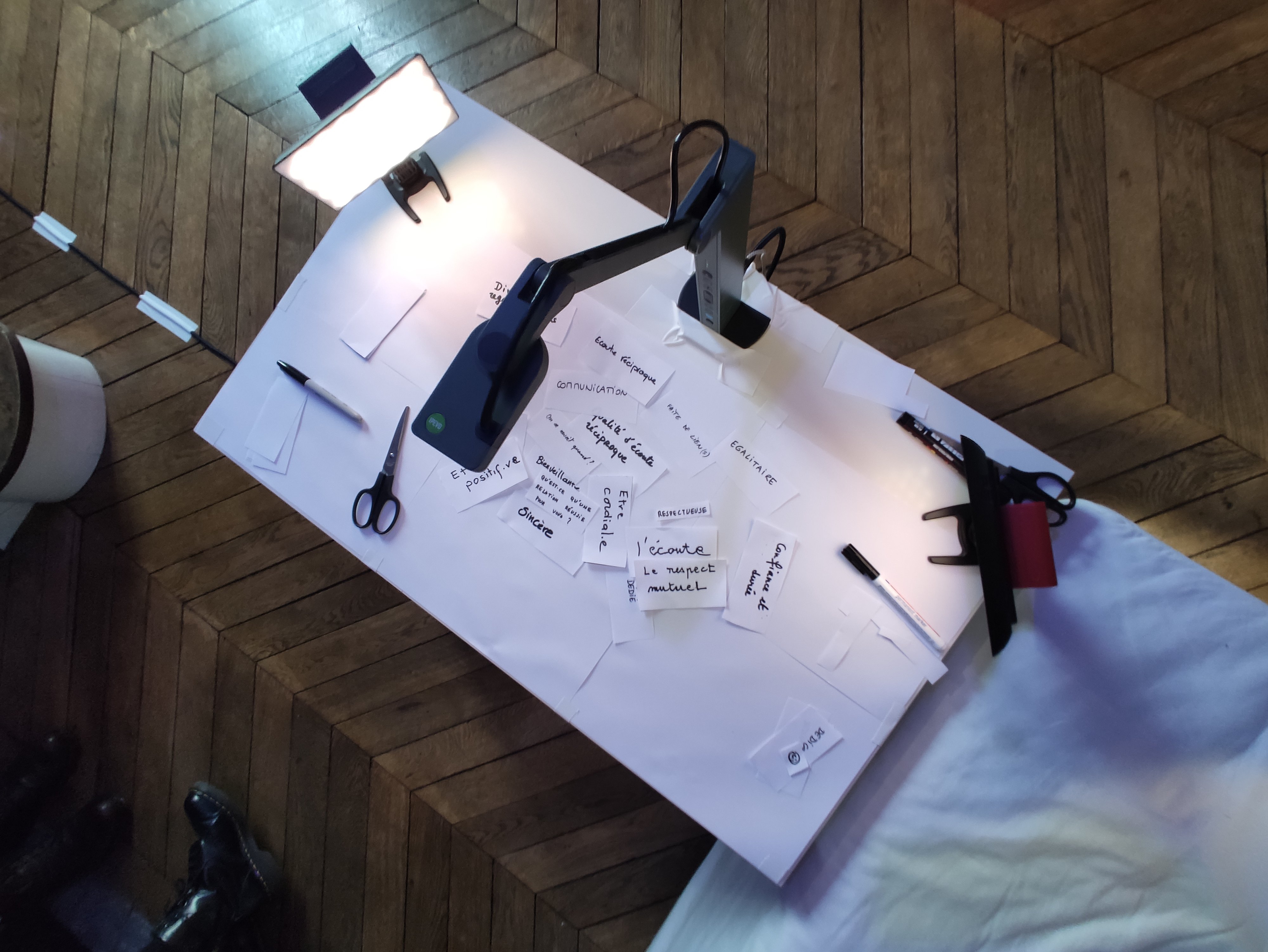
In June 2022, the team finalised a framework document, the “Boussole de la médiation” (mediation compass), a reference guide in eight axes, written collectively and based on syntheses made by the staff themselves. This is the document that brings everything else together and gives it its “why”. In it one can read a definition of cultural mediation worked out by the team, “bringing a social experience to life through art and culture” and “transforming every actor of mediation”, inhabitants and professionals alike, “enriched by the gaze of the other”, with no hierarchy between people’s cultures, in the spirit of cultural rights. In it one can read the project of a “politics of the relationship” based on people’s journeys rather than on the attendance needs of the facilities, the ambition to be “seismographs” listening to inhabitants’ desires, the will to build together, summed up by an image born in session: “not building a ceiling or a wall, but windows”. And in it one can read a useful distinction between mediation and communication: communication consists in sharing information about the actions, mediation in sharing their contents, and creating a video platform, for instance, is an act of mediation.
But the subject is not the document, the subject is the process that led to it, and this document only makes sense if the process continues: it is, moreover, designed to evolve. Étienne Wenger, in “Communities of Practice” (1998, French translation published by Presses de l’Université Laval in 2005), argues that engagement in a shared social practice is the fundamental process through which we learn, and he observes that “community maintenance” is a dimension of any practice that often goes unnoticed and is easily underestimated. We took this dimension seriously: the time spent together moving around, creating, formulating, was part of the work itself.
The city buys its own equipment
In 2023, the city’s services bought their own digital mediation equipment, cameras, audio recorders, tripods, rostrum camera, lights, video projector, drawing up the list from everything the teams had experimented with using mine since 2017. The September 2023 training session was carried out with this equipment: getting to grips with it, facilitation methods, technical instruction sheets, mediation scripts. A few days later, a full day brought together the after-school youth workers, then the intergenerational workshop of 4 October 2023 already took place in this new configuration. And the very last handover training session, again based on their own equipment, took place on 5 September 2024.
Donald Schön, in “The Reflective Practitioner” (1983, French translation published by Éditions Logiques in 1994), shows that professionals, to overcome the challenges of their practice, rely less on the formulas learned in their initial training than on knowledge built in action, through a “reflection-in-action” that mostly remains unarticulated. This is the wager on which I built the whole Les Lilas project: never separating training from action, having the staff learn by doing, at my side at first, then less and less at my side. The training sessions on their own equipment, as a final stage, were only the formalisation of knowledge already built in action.
People change, the experiences remain
Isabelle Altounian, who had carried this whole project, left the city in 2023 to change her life. A new director of cultural affairs arrived, some things were handed over to her, her priorities are different, which is normal. Staff had already changed during the process itself. And yet, the last tool-appropriation training session was held a year after this departure, with largely renewed teams. Despite the changes, there was continuity, and what the teams do with all this today is fully their own. That is what counts. It should moreover be anticipated from the start, because in a local authority people move, elected officials change, and a world where everyone would stay in the same position indefinitely would not be an ideal world anyway.
The goal was never to transform the practices of a cultural affairs department; it was to work differently, with digital tools, on precise aspects: the relationship with young people, the logic of mediation in the field, the very thinking of mediation in the light of cultural rights. What happened had value in the present first: hundreds of inhabitants created films, people met one another, teams discovered methods, somewhat renewed, somewhat surprising, sometimes joyful ways of working together. These ways of working do the teams good, and this is also how the relationship with the public transforms, because the teams discover other dimensions and invent together. In the article John Dewey : an inspirer of cultural rights ? I developed this idea, drawn from pragmatist philosophy, that lived experience is itself constitutive of the work and of its value. The skills acquired, the experiences lived, the standards and values that permeated these years are the essential part of what remains; the tools, the platform, the compass are their traces, available for those who will come next.
I keep one simple conviction from it all: movement has to be lived and experienced together, to make a real path.


