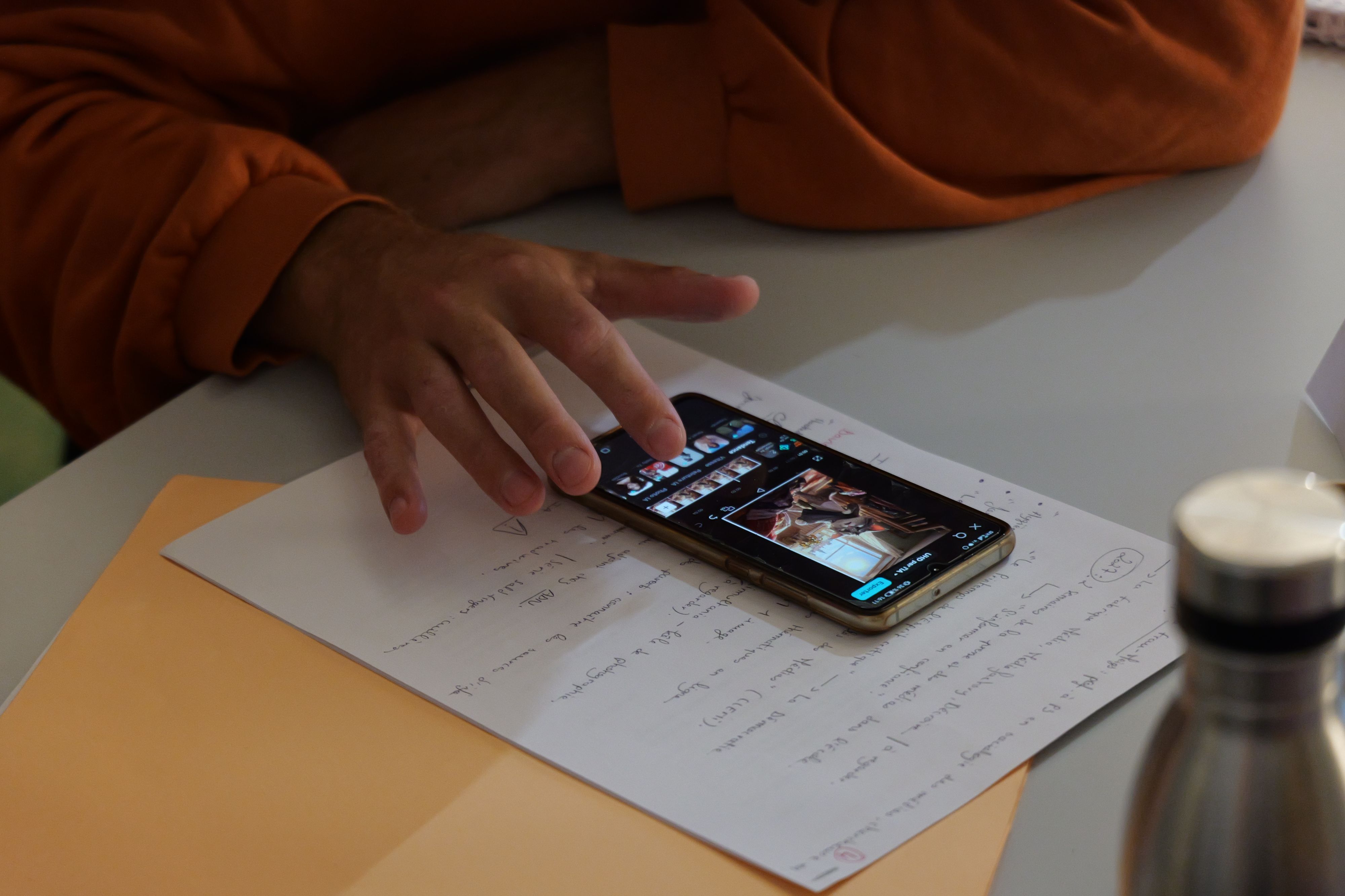
Working in pairs, the trainees wrote a script of two or three scenes, generated one image per scene with an AI, then animated the images and recorded the voices in CapCut. The films came quickly, too quickly for several participants, who said they had lost their grip on what they were making. In my view, that experience, lived and then discussed together, is what makes the workshop worthwhile, much more than the films themselves.
Stepping aside through creation
The three-day course was organised by Images en bibliothèques together with the Bpi. The participants had worked with the journalist Louise Bartlett on media and information literacy, with Florian Lecron on how images relate to reality, with Céline Gilly on the media literacy programmes that can be set up in a library, and, on the Friday morning, with David-Julien Rahmil, from L’ADN, on the history of web videos, from memes to the AI-generated videos now known as slop. When he introduced me, Florian Lecron pointed out that artificial intelligence had come up throughout the three days, but that no one had used it yet.
The workshop I offered is based on one I designed with the team of the Studio 13/16 at the Centre Pompidou during the February 2024 school holidays: two weeks of open participation, in which teenagers came in to make a film with AI tools, some in half an hour, others coming back several times (I wrote about it here). I then adapted it for TUMO Paris, the digital creation school based at the Forum des images: groups of seventy teenagers in a cinema auditorium, for two and a half hours, writing, making, screening and discussing their films (TUMO x IA : voyages créatifs au cœur de l’IA). I had already taken part in this course last year: about fifteen librarians had made dystopian futures, poetic music videos and documentaries about the media library, and we had had time to screen the films but not to discuss them (I wrote about it here). This year I kept the short format, so that each person could take pieces of it back to their own audiences, and I set time aside for the exercises that prepare the making and for the discussion that follows it. Those are mostly what I describe here.
I explained why I work through creation. In media literacy we talk a great deal about true and false, and these questions quickly polarise a group. When people make up a story, they are working with the imagination, the atmosphere is more relaxed, and it seems to me that critical thinking comes all the same, perhaps better. I also told the story of the Pocket Films festival, which I founded in 2005 with the Forum des images, when cameras first appeared in mobile phones. We were accused of playing into the hands of industry, and of believing that a film could be made without a real camera. My answer was that in ten years everyone would have a camera in their pocket, that this would change our lives, and that the point was not to decide whether it was good or bad but to experiment while it was happening. I think the same about artificial intelligence today.
Stand up if the answer is yes
To begin, I asked about ten questions, which people answered by standing up if the answer was yes. Who has used a generative AI this week? Who has ever said thank you or please to one? Who has ever asked one to write an email for them? Who has ever followed their GPS while sensing it was wrong? Who has ever been fooled by a generated image, to the point of sharing it? Who would let an AI choose the films their media library buys? Nobody, and someone added that this was precisely a task they enjoyed. Who thinks an AI could do part of their job within one, two or ten years? Who would like to see an old photograph of their ancestors come to life? Who thinks a film made with an AI can be a work of art? I stood up too whenever my answer was yes.
One participant pointed out that I had not asked who had never used these tools. Two weeks earlier, in another training session, most of the room had never done so, either by choice or for lack of curiosity. I had naively assumed that everyone had tried them. I asked the question: here, everyone had, and one participant added that it was sometimes despite herself, since Google now displays generated answers without being asked.
This short exercise, which I call sit-stand, lets each person take a position in front of the group without having to argue for it, and gets everyone moving. The questions should sting a little, but not so much that some people no longer dare to declare themselves. After the last question, I mentioned the residency I will lead in February 2027 for Nef Animation, as its common thread: a month in Nantes, with ten animation filmmakers, on generative AI and the ecology of narratives. The subject creates very strong tensions in that profession, and it is a good thing that people are debating it.
One participant mentioned people who refuse these tools for environmental reasons. I shared a calculation I made, deliberately one-sided since I am a vegetarian, and which I presented in an article: the footprint of one steak is roughly that of four thousand prompts. I am not saying that AI has no impact; it does. I simply notice that I feel guilty when I write a prompt, and that I never asked myself any questions when I used to eat meat. We are first of all in contact with the imaginaries we project onto reality, and this is the point I later developed in the essay “L’éducation aux médias commence par nos imaginaires” (Media literacy begins with our imaginaries).
From the golem to Dialector
I asked who felt comfortable with what artificial intelligence is and how it works, then gave, in less than ten minutes, a parallel history of artificial intelligence and cinema. The aim was for everyone to start with a minimum of shared information, and so to feel entitled to take part afterwards. I talked about the golem; the Mechanical Turk, a chess-playing automaton that toured the courts of Europe at the end of the eighteenth century with a player hidden inside its cabinet; Blaise Pascal’s Pascaline in 1642; the binary arithmetic Leibniz described in 1703; the notes Ada Lovelace added in 1843 to her translation of an article on Charles Babbage’s Analytical Engine, in which she describes what would later be called programming; and Alan Turing’s test in 1950. For cinema, HAL in 2001: A Space Odyssey in 1968, Terminator, The Matrix. Then Deep Blue, which beat Garry Kasparov at chess in 1997, and AlphaGo, which in 2016 played Go moves against Lee Sedol that no human had imagined and that players have studied ever since. I recalled that the term “artificial intelligence” dates from 1955, and that I would rather speak of automated cognition. I ended with Chris Marker, who in 1988 programmed one of the first chatbots, Dialector, on his Apple II, and which can be used online today. With an audience, you can also ask people to name the films they know in which machines think, which is often livelier.
A minute and a half each
I then asked everyone to pair up with their neighbour. For a minute and a half, the first person tells the other what they see as the risks of artificial intelligence, then they swap; then the same exercise with the benefits. A countdown was shown on the screen. As Florian Lecron was on his own, I did the exercise with him. For him, the first risk was losing our creative power by handing the most interesting tasks over to machines, at work as well as in our leisure time. I told him that I, for my part, believe there is a risk of humanity disappearing, and he replied that some people have an interest in spreading these catastrophist discourses. I agreed: this too is an imaginary. On the benefits side, he saw the chance to be freed from alienating tasks; I added that if what defines us as humans is no longer cognitive ability, we are left to cultivate something else: intuition, chance, what we live through.
I then explained why I have people do this exercise before creating anything. It is easy to ask people to make a nice drawing or a film, but when it is our turn to do it, we do not necessarily feel capable. In pairs, among peers, nobody checks or judges, and the exercise is so short that someone who does not know what to say is not put on the spot. With seventy teenagers in a cinema, everyone talked at the same time, and everyone spoke. The countdown acts as a third party: an object holds the rule, rather than a person who would have power over the others. Putting into words what you have just heard is also what psychoanalysis calls symbolisation, which I described in L’être écrivant: by putting things in your own words, you make the information your own and build yourself. I take part in the exercises I propose, so as not to place myself above people who would have taken a risk I had not taken.
A profession behind every step
While I was presenting the method, a participant first asked whether there would be time for discussion after the films. She then said she had a real ethical problem with this workshop, and that she had known it when she signed up. Behind every step she saw a profession: screenwriter, historical adviser, film editor. She did not think she would change the world by refusing these tools, but for her it was a matter of principle, and she added that to criticise a tool, you also need to know how to use it.
I told her that her position was entirely respectable, that I would never say these tools must be used, and that at TUMO some teenagers had left the workshop even more opposed to artificial intelligence, while others were glad to have discovered new possibilities. I believe artificial intelligence will replace many jobs, just as the combustion engine upended those in transport, and that the professions concerned will have to reinvent themselves, which is hard. I added a remark on method: when you are responsible for a collective space, your role is to welcome disagreement, whichever way it goes, because we are enriched by points of view that are not our own.
One image per scene
The method follows the classic stages of filmmaking. You could ask an app for a video straight away, but the free credits run out after the first one, and above all, is that making a film? Going through an intention (what do I want to tell?), then preparation, then making, means setting yourself a standard, the standard of a cultural offer.
For the script, each pair chooses a theme, a formal approach (a character speaking to camera, talking objects, a music video, a two-character fiction) and some content (a period, props, a stake). The AI can be used as a search engine that writes summaries, to find out more about the Middle Ages for example, and then to help with writing: it easily reproduces the conventions of a screenplay, which helps people who find writing difficult. I asked for two or three scenes, no more.
For the storyboard, you generate one image per scene. With only three images, people take the time to get the one that matches what they want, and the two of them discuss their choices. Each tool’s biases and gender stereotypes also show up very quickly; I preferred the days when generated images were distorted, almost surreal, to these images that are too well made, within a rather poor Western culture. I recommend Poe, which gives access, with a limited number of credits, to models from several makers, and lets you send the same request to several of them. Someone said this was polytheism, and that remark is the origin of the essay “Pas un dieu, des industriels” (Not a god, but manufacturers). But Poe’s free offer has shrunk a great deal: several pairs used up their credits, and I pointed them to two almost free models, Z-Image Lightning and Retro Diffusion, or to the ChatGPT or Gemini app they already had on their phones.
For editing, I demonstrated CapCut, the free app made by ByteDance, the company behind TikTok, which can be used without an account as long as you turn down every subscription offer. You import your images, animate them with effects such as Zoom 3D or Autofill (the latter invents the setting around the image), delete the closing logo, switch off the “UHD by AI” option before exporting, and record the voices yourself, as dubbing: synthetic voices are quickly recognisable, and acting is more fun. If you have used a paid effect, you can play the film full screen and record the phone’s screen. It was 3:23 pm when I finished presenting the outline, and the workshop ended at 4:30 pm. I allowed ten minutes for the script, until about 4 pm for the images, then ten minutes for editing.
A gasworks, a heatwave and a dog
Several pairs had not been able to export their film because of paid effects. So we watched the films on their phones, placed under the camera connected to the projector, in the dark, and several pairs did the voices live. In one film, a voice wondered what the Saint-Mandé gasworks looked like, decided to ask ChatGPT, found itself inside, then was carried off into the future without anyone quite understanding how. In another, characters complained about the heat and the lack of water, and someone in the room added that this was because of artificial intelligence. In a third, a voice cried out: “We are here to save you.” A silent film, with speech bubbles and a striking effect at the end, would have gained, as I said, from leaving each image on screen for longer. I had made my own for the demonstration, a dog attacking the Bpi, and someone pointed out, rightly, that it was off topic.
The pairs who had managed to export then uploaded their film to an online space reached through a QR code, where I also put the photos taken during the workshop. It seems important to me to keep a trace of what we made, even in a few minutes. I had also put there the link to the films made by the TUMO teenagers, so that people could see what the workshop produces when there is more time.
“I thought it would be more balanced”
We had about ten minutes left to talk, and the discussion started straight away. Someone said they had expected the workshop to be more balanced between us and the AI, and had felt very dependent on the tools. I agree: the machines produce a result at once, and even with a three-stage protocol, it goes too fast. We need to invent strategies to keep control.
A participant who does not like using these tools said she had once had a long dialogue with an AI to see how it would react. She gave a piece of advice, noting that nobody is trained in it: write at the start of the conversation that you do not want it to keep confirming what you say, and that it may contradict you, because these tools tend to flatter, which is a problem for people who use them as a therapist. In her pair, the AI had in fact gone well beyond their script and offered far more than they had asked for. I said it was worth feeling that, the near-disappointment of having nothing left to do.
A participant noted that you have to be very precise in what you ask, and that the tool could be used to learn screenwriting, since a script must already make you see the images; he was both impressed and worried to see how much a machine produces from three sentences, with surprises, such as an image of the emergency department “of the Lyon hospital”, in the rain, although nobody had mentioned Lyon. Someone else said they would not want to begin image education with children or teenagers this way, but with something more mechanical, stop-motion for example, where you understand that a zoom comes from the camera. Another person could not really see what had been creative in what their pair had made, whereas she knows artists who do fascinating work by questioning these tools.
A workshop for critical thinking
I share most of these remarks. I would not offer this workshop as a first image-education workshop; I run many cut-out paper workshops, filmed live with a camera mounted above the table, the OBS software and a microphone. This one suits people who have already made images and are discovering another way of working. I also think that in audiovisual creation workshops, much more beautiful things are made without artificial intelligence, and I personally prefer other workshops. The value of this one lies elsewhere: realising how little grip you have on what you make with these tools, talking about it together, learning to use CapCut along the way, and no longer being alone in thinking about these questions. Our experiences with these machines are often intimate, and sharing them in a group makes it easier to talk about them.
We had also run short of time: less than ten minutes to write is too short to really engage with a subject, and we had mostly checked that the chain worked from start to finish. At TUMO, with more time for each stage, I had been surprised to see how much the teenagers wanted to tackle a real subject, and how different their films were from one another although they had been made in the same time and with the same tools.
Florian Lecron closed the workshop by recalling that in image education the process matters more than the result, even though I am keen to keep every workshop film as a collective memory, and he encouraged everyone always to plan, after the making, a time for showing and a time for discussing. In the review of the three days, one participant regretted that the trainees had shared their experiences less on Thursday and Friday than on Wednesday. Images en bibliothèques plans to give these experiences more visibility, and will hold a webinar in a year’s time on experiences with cinema and audiovisual work in libraries.


