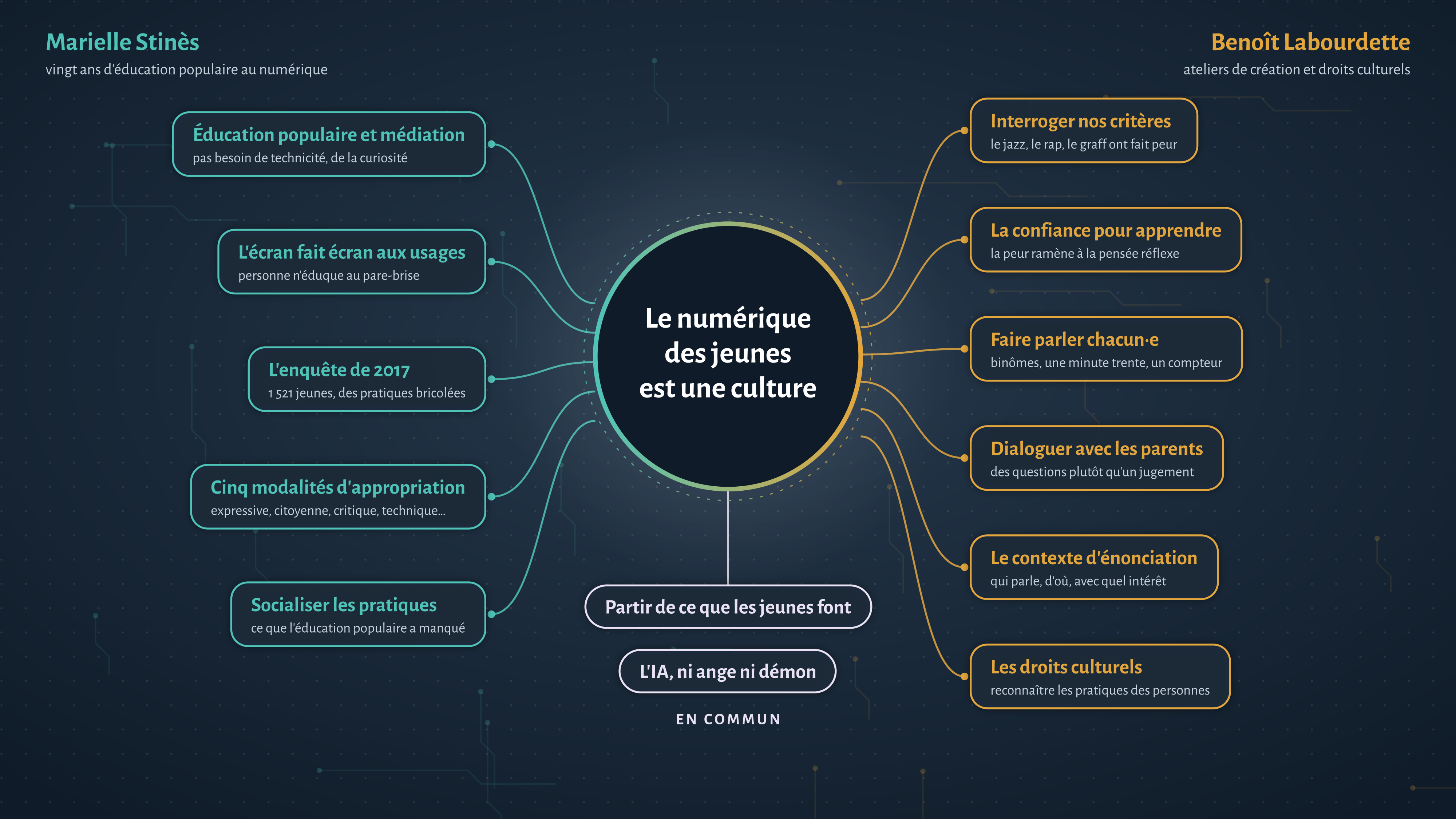
In 2026, the public debate on young people and digital technology took the form of a law: in July, Parliament voted to ban social networks for children under 15, and in August the Constitutional Council struck the ban down in the name of freedom of expression. In this climate, we suggested to popular education professionals that they start from what young people actually do. Marielle Stinès presented the survey the collective carried out in 2017 with 1,521 young people, and the two diagrams she drew from it, which allow a team to choose a line of action without feeling incompetent. I put forward methods for questioning our own criteria, getting everyone to speak and working with cultural rights, as well as advice for parents.
The regional conference on popular education and digital culture
The Educpopnum collective brings together, in Nouvelle-Aquitaine, volunteers and staff from associations, elected officials and local government professionals, teachers and researchers who work on the links between popular education and digital technology. It asks itself two questions, which its programme puts this way: how can digital technology be a source of emancipation, participation and social transformation, and how can we move towards a digital world that is more ecologically sustainable, economically fair and socially equitable? It was born in 2006 in Poitou-Charentes, under the name “EduPop TIC”. The CRAJEP Nouvelle-Aquitaine, which federates the region’s youth and popular education movements, coordinates and runs it with the support of the regional delegation for youth, engagement and sport (DRAJES). The collective held conferences in Niort in 2014, Bordeaux in 2016, Limoges in 2019, online in 2020 and Angoulême in 2024, and it carried out three surveys on the digital practices of young people in the region, in 2017, 2019-2020 and 2023-2024. Several times a year it also organises open days for youth professionals.
The 2026 conference was titled “Democracy and living together in the digital age: popular education to the rescue?”. It took place at Le 125, a youth third place in Bordeaux, in front of youth workers, educators, digital mediators, local government staff and a few parents. Siegfried Burgeot coordinated it for the CRAJEP, with the collective’s steering committee, and it was at his invitation that we prepared the closing lecture together. The first day opened with a round table chaired by Jean Massiet, with the psychologist Vanessa Lalo, Nathalie Richard for Arcom, Jennifer Elbaz for the CNIL, Maximilien Saint-Cast, co-founder of EDUKIA, Pierre-Mary Gimenez-Guillem, from the Le Florida music venue, and Roland Étié, from the Espace Camaïeux community centre. Eleven workshops followed over the two days, on young people’s mental health, a free software tool for associations, radio, games on critical thinking and artificial intelligence, the Promeneurs du Net network, and data made tangible by Les Petits Débrouillards. Our two-voice lecture closed the conference.
Marielle Stinès was one of the collective’s founders, and left it in 2016. She now works at the DRAC Normandie (the regional office of the Ministry of Culture), and she spoke in a personal capacity. She told the story of the collective in an article in the Cahiers de l’action of INJEP in 2017, and in 2018 she published, on Echosciences Normandie, “For a popular education in digital culture open to young people’s practices”, the source of the diagrams reproduced below. For my part, I spoke from twenty years of creative workshops with young people and adults, from the Pocket Films festival that I founded in 2005 with the Forum des images, and from my work on cultural rights.
A law struck down, and two books to read by “arpentage”
The subject is controversial, and our position is not unanimous, even among youth professionals. Since La Fabrique du crétin digital by Michel Desmurget (2019), a health discourse has taken hold that describes screens as a threat to children’s development. The “Children and screens” commission, co-chaired by the neurologist Servane Mouton and the psychiatrist Amine Benyamina, submitted a report to the President of the Republic in April 2024 recommending no screens before the age of 3 and no phone before 11. Servane Mouton extended this work in Écrans : un désastre sanitaire. Il est encore temps d’agir, published in Gallimard’s “Tracts” series. The law passed in July 2026, at the initiative of the MP Laure Miller, banned social networks for under-15s and phones in high schools; on 14 August the Constitutional Council struck down the social network ban, finding the infringement of freedom of expression and privacy disproportionate, and the President of the Republic asked for a new version. Servane Mouton publicly regretted that a measure to protect minors had thus been “buried”.
I showed these two books during the lecture, saying that I did not recommend them, and yet suggesting that people read them. Not everything in them is wrong; it is the argument that seems fallacious to me, because it relies on part of the facts and presents it as the whole, and presents it as scientific fact. In Youth has not lost its mind I explained what the most solid studies on the effects of screens say, and do not say. But these books contain the arguments that are put to us, and we need to know them in order to position ourselves. Servane Mouton’s tract is cheap: it can be read with teenagers through “arpentage”, a popular education method in which the book is cut up, the pieces handed out, and each one discussed. Intermediate positions are also under attack. The psychiatrist Serge Tisseron, with whom I often work, offers normative guidelines, the “3-6-9-12” rule, which I find rather theoretical; because he seeks nuance, he is accused of being complacent towards the big platforms, which is false for anyone who knows his work. Vanessa Lalo, who spoke the day before, rails against demonisation, with a stance I do not always share. The journalist Salomé Saqué showed in Sois jeune et tais-toi (2023) that the stigmatisation of young people is very old.
Questions of dopamine, addiction and regulation also exist, as I said during the lecture, and in the audience several people reminded us that some parents are struggling, that some young people are in distress, and that we must not fall into naivety. We suggested shifting this debate rather than closing it, by looking at what young people do before deciding what to forbid them.
Marielle Stinès, from the metonymy of the screen to five forms of appropriation
Marielle Stinès first distinguished popular education in digital culture from digital mediation, which emerged in the same years and is now more often called digital inclusion. “Digital mediators have technical skills; popular education in digital culture does not require them,” she writes. A youth worker can run a project without knowing how to code, and turn to mediators for technical skills when needed. The main obstacle, in her view, is the feeling of incompetence that comes from a technical idea of digital technology. The condition is curiosity about uses, and it starts by talking with young people: “One hour of discussion with young people about their digital practices is a year’s worth of educational projects.” She gave the example of Rurart, where young people presented their everyday practices to parents, with a digital mediator at their side.
She then questioned the word “screen”, which she sees as a formidably effective metonymy in communication. By gathering all tools and all uses behind this word, we keep uses at a distance, feed moral panic, confuse news items with social facts, and spare ourselves the trouble of taking an interest in what young people do. Nobody talks about “windscreen education” when learning to drive: we look at the road through it. Yet adults say that young people “consume screens”. To support them, we have to go beyond the screen, towards their informal knowledge, knowing that one use may hide another.
This is what led the collective, in 2017, to carry out a survey-training-action project, run with the CRAJEP and supported by INJEP. The collective was debating at the time: is the web a space for informal learning, or does it reinforce inequalities of cultural capital? The available surveys mostly measured time spent in front of screens, and sorted activities into “playing”, “listening to music”, “watching videos”, a typology that ignored the interactivity of the web. The survey combined a questionnaire, answered by 1,521 young people aged 11 to 18, and discussion groups in a rural area, in a priority neighbourhood and in the youth council of Poitiers; the latter, though the most privileged, turned out to be the most anxious, with parents closely involved in controlling their uses. Among 12-15 year-olds, gaming and relationships dominate, but 6.4% read fanfiction, 9.2% translated song lyrics, 15.2% had created a video channel and 34.9% retouched images. These marginal practices are a minority and yet important, because they feed a variety of learning. Young people “tinker with their practices”, says Marielle Stinès, and each builds a singular path through digital culture, like the girl who loved cats and taught herself HTML to make apps.
In 2018 she drew two diagrams from the survey, for a practical reason: the word “digital” covers so many things, from robotics to fake news, that a youth work team struggles to find its way and to act. In the first, she sorts practices according to whether they are spontaneous or supported, online or offline.

In the second, she distinguishes five forms of appropriation, which partly overlap, and links them to areas of educational intervention.

Civic appropriation means sharing information, giving one’s opinion, defending a cause, belonging to communities of interest and knowing their codes; it can be supported through free culture, participatory mapping, civic wikis, and education about the internet, its history and how it works, which according to Marielle Stinès has almost never existed. Critical appropriation draws on the critical arsenal that young people forge among peers, on privacy, disinformation, online reputation or harassment; it needs dialogue with adults and legal reference points, and she suggests talking about fake news but also about whistleblowers and alternative media, about data plundering but also about open data. Expressive and creative appropriation covers translating songs, film reviews, fanfiction, filmed choreographies: these are new forms of amateur practice, in which one can, in the words of the sociologist Patrice Flichy, “move freely within one’s passion”. Technical appropriation is the least spontaneous, highly valued by fab labs and public funding, and then brought into technology lessons; Marielle Stinès thinks code should be learned the way we learn to read and write. “Professional” appropriation, finally, is the one adults look at most, judging young people’s digital agility on a spreadsheet or an email, that is, on what is furthest from their uses.
These diagrams help to pull one thread, for one year, to carry out an action, without feeling incompetent. Marielle Stinès concluded on what popular education has missed: taking a real interest in young people’s practices, and socialising them, giving them a place in the places where young people live alongside adults. The collective did this for video games, with festivals, and there were competitions for pocket films, fanfiction and “sweded” films, and a workshop at the agricultural high school in Rouillé where gamers wrote in their CVs that they knew how to lead a team or give feedback to their teammates. On artificial intelligence, she suggests the same method, being curious, observing, documenting, objectifying: “Making AI an angel would be as absurd as making it a devil.”
My part, from our criteria of judgement to cultural rights
I opened the session with a game I often use, sitting-standing. At each question, the people concerned stand up: do you spend more than three hours a day in front of a screen? Have you ever confiscated a phone? Do you think social networks are dangerous for young people? Do you think young people use digital tools better than adults? Have you learned something from a young person recently? Do you have TikTok on your phone? The room sees its own practices and its own opinions, and everyone discovers they are not alone in their case. Standing up is already asserting something in front of others, and this needs preparing: I always start with a question with no stakes, so that everyone understands the game before the questions that commit them.
Someone asked what share of young people’s practices was worthwhile, and what share was consumption. I think we first need to ask where our criteria come from. Jazz, rock, rap, techno and graffiti were all judged dangerous before entering conservatories and museums, and Marielle Stinès recounted that as a child she was reproached for reading too much, a practice now highly valued. Our judgements on young people’s practices come from our history and background as much as from what we observe, and I include myself: I have criteria, and I consider that my work consists in deconstructing them, in dialogue with young people, which is probably the hardest part. The psychologist Olivier Houdé showed in Apprendre à résister (2014) that learning requires resisting one’s own reflex thinking, which costs the brain a great deal of energy, and that fear, of judgement or of a bad mark, brings us straight back to it. Trust is therefore a condition of learning, and of critical thinking.
To get everyone to speak, I proposed an exercise in pairs, a minute and a half each, with a timer projected on the screen: first one’s own digital practices, what one likes and what worries one, then, with another partner, the last time a young person taught us something. In six minutes, everyone in the room had spoken. Speaking is working through what one lives; in pairs, one speaks without the gaze of an adult in a position of authority; and the timer acts as a third party, since it is not the facilitator who cuts people off. Jacques Rancière told the story of Joseph Jacotot in The Ignorant Schoolmaster (1987), and drew from it the idea that explaining first sets the other person up to believe they cannot understand alone. In my creative workshops with artificial intelligence at TUMO, at the Forum des images, I show more than I explain, and the teenagers compare the tools’ biases themselves. I also said that these tools raise serious ecological and political questions, and that they democratise writing: a CV or an email without spelling mistakes gives confidence to people whom writing, as it is taught, has long kept on the sidelines.
I ended with cultural rights, set out in the Fribourg Declaration (2007) on the basis of Article 27 of the Universal Declaration of Human Rights, and cited since in the NOTRe law of 2015 and the 2016 law on freedom of creation. They understand culture in the anthropological sense and recognise everyone’s freedom to choose their communities of belonging. What I look for there is the link between cultural democratisation, which gives access to works, and cultural democracy, which recognises people’s practices, without giving up one for the other. This takes more work, and I showed it with films shot in several languages about their rights by residents of the shelters run by the Entraide et Solidarités association in Tours. We were in a small, bleak room in an emergency shelter, but we had set up a camera above a table, paper to cut out, instruments, and signs saying “film studio”, “cutting workshop” or “music studio”. These signs are symbols: they give importance to what we are about to do, and I learned this in particular by working with autistic children, for whom a modest object can carry a great deal of meaning. In Giving room to others takes more work I explained why I do not show films made elsewhere first.
My advice for parents
Parents came up again and again in the discussions. A youth worker who works on parenting described his position, between parents who count hours of screen time and young people who talk about what they do; a participant pointed out that only parents who are already convinced come to the evenings organised for them. Here is what I suggested telling parents:
- Take an interest in what your children do, rather than in the time they spend on it. Take time to talk about it with them, ask them what they do, without telling them they are right or wrong, because judgement puts everyone on the defensive, teenagers and adults alike.
- Ask yourselves questions together. The questions you ask your children about their practices, you can also ask yourself, and talk about them as a family.
- Use a list of questions written in advance. I suggested that youth workers print one for parents to ask their children: the list is not normative, it does not put anyone in one camp or the other.
- Do not judge practices wholesale. Parents who judge their children’s practices without knowing them lose their trust: a young person harassed online will not dare talk about it if they expect to be judged on everything they do, without being heard in the nuances.
- Build guidelines with parents, not for them. A mother asked me whether there was a typology of parents, because she saw some who played video games more than their children. I think a typology can help as much as it can confine, and that it is better to invent it with parents, during the session, and then look for the books afterwards.
A participant added other advice, which I gladly take up: create a climate of trust, set an example (no phone at the table), and stay vigilant, because some young people are not doing well. When that is the case, the screen is not the cause, and the problem does not disappear if the screen disappears; one must then know how to welcome and simply listen to desperate parents. A participant reported a teenage girl’s words in a workshop on mental health: “AI worries me for my parents, they swallow anything.” Young people are not the only ones who need media education.
The context of utterance
Having a critical mind means first knowing where a piece of information is spoken from, by whom, in what setting and with what interest, what is called the context of utterance. A journalist and an influencer have neither the same means nor the same working rules; without one necessarily being worth more than the other, they speak from different contexts and with different aims, and we can take that into account. For my part, I read a lot of print press, on paper, and I also follow accounts on TikTok, including foreign ones, and groups on Telegram, whose orientation at least has the merit of being explicit: it is the diversity of sources, more than sorting them, that allows me to form an opinion. I discussed this during the conference with staff from Arcom, and I believe many young people know it better than we think. It is a starting point for working with them.
A step still being played down
The participant who had spoken about parents added that artificial intelligence is a new step, whose effects are still being played down, because it goes beyond screens and affects jobs as well as ways of thinking, and he suggested that the collective open a real reflection to prepare for it.


