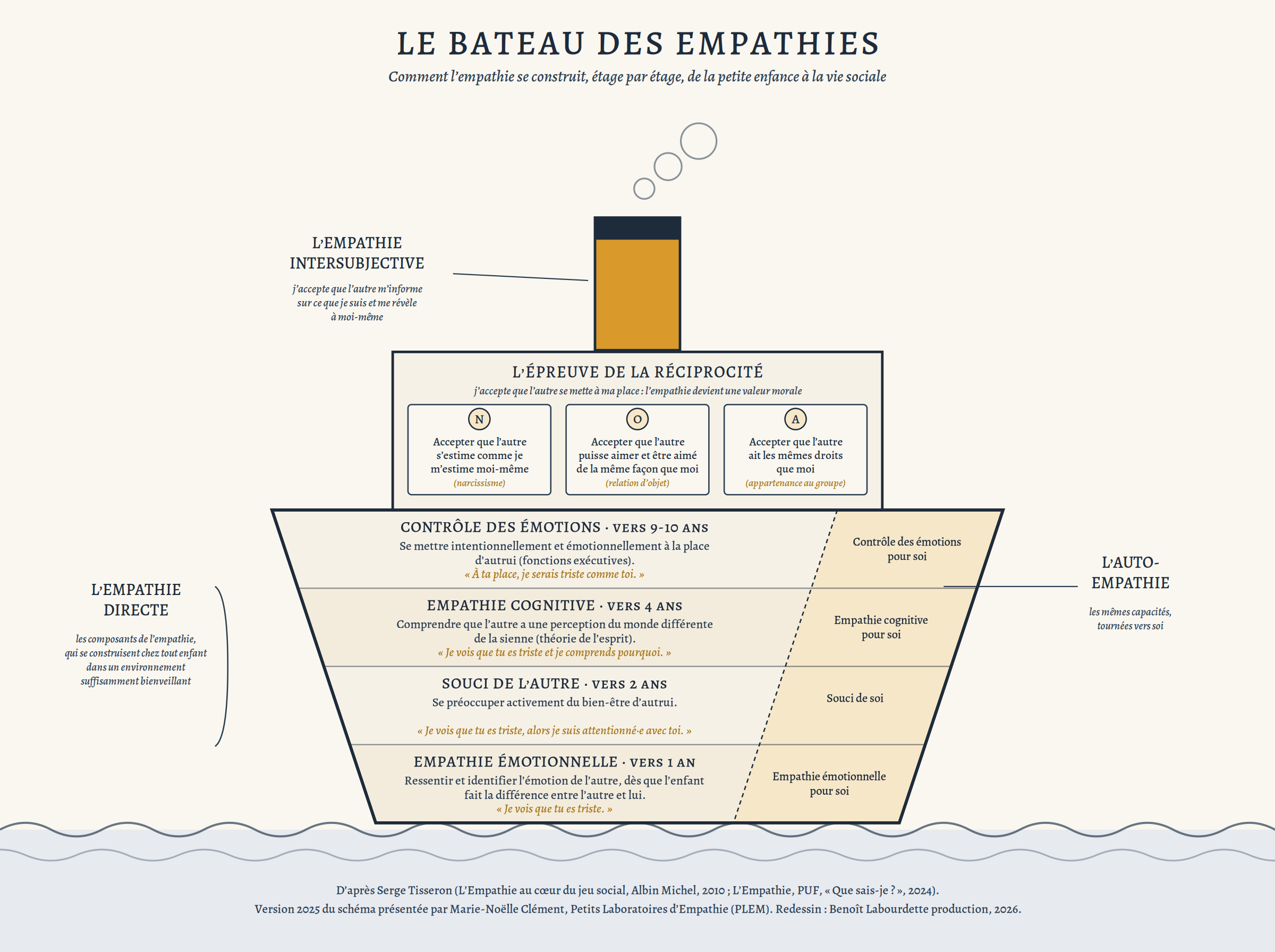
Serge Tisseron pictures empathy as a boat: the hull of capacities built in childhood, the deck where reciprocity is put to the test, the funnel of intersubjectivity. Professionals working with adolescents can use it as a developmental map, without turning it into an assessment grid: understanding what a young person has been able to build, and what their history has damaged, changes the way we look at behaviours that disconcert us. This understanding also carries very concrete methodological consequences: with Serge Tisseron, we set the processes of empathy to work in the very form of creative workshop protocols. I present the model here, in its 2025 version, which I have redrawn, and then the method.
“He has no empathy at all”
The phrase comes up again and again in team meetings, about a young person who has hit someone, humiliated someone, or watched another’s distress without reacting. Serge Tisseron, psychiatrist and psychoanalyst, with whom I have been working for over fifteen years, answers differently: empathy is built, layer by layer, within relationships, from the first year of life onwards, and adversity can damage it; speaking of a young person as being deprived of it by nature therefore makes no clinical sense. It must first be distinguished from its neighbours. The child psychiatrist Marie-Noëlle Clément, who runs the CEREP day hospital for children in Paris and works with Serge Tisseron within the Petits Laboratoires d’Empathie, defines it along three dimensions: understanding what the other person is going through, being touched by what they are going through, and doing something helpful with that understanding. Sympathy, for its part, consists of being swept up in the other’s emotion, to the point of sharing their values and their goals; compassion places the emphasis on suffering, presupposes a victim to be defended, and sometimes comes with a feeling of superiority that leaves little room for reciprocity. Equipped with these distinctions, we read situations differently: a young person who seems indifferent to another’s suffering is not necessarily “without empathy”; they may be protecting themselves from being overwhelmed, or their empathy may not have found the conditions in which to build itself. During a training session we gave together in Saint-Denis in 2016, Serge Tisseron reported observations that child protection teams recognise immediately: young people who have suffered assault come to simplify their reading of other people’s facial expressions into two categories, the explicitly benevolent and the doubtful, hence threatening. This mistrust, which we readily take for a character trait, is an adaptation to what they have lived through.
The hull, the deck and the funnel
Serge Tisseron first described empathy as a three-storey pyramid, in L’Empathie au cœur du jeu social (Albin Michel, 2010), then gave it, in 2014, the form of a boat, which speaks more directly in training contexts. In its current version, presented by Marie-Noëlle Clément in 2025 during a joint day for the judicial youth protection service of the Limousin, and which I redraw here, one distinguishes the hull, the deck and the funnel:
- The hull holds the components of empathy, which build themselves in every child within a sufficiently caring environment:
- emotional empathy, around age one, as soon as the child tells the difference between the other and themselves and perceives the other’s emotion;
- concern for the other, around age two, when the child actively worries about someone else’s wellbeing and hands a toy to a crying adult;
- cognitive empathy, around age four, when the child understands that the other has a perception of the world different from their own, what psychology calls theory of mind;
- the control of emotions, finally, around age nine or ten, which relies on the executive functions and makes it possible to put oneself intentionally in another’s place without being overwhelmed, “in your place, I would be as sad as you”.
- The same hull, turned towards oneself, forms self-empathy: identifying one’s own emotions, caring about one’s own wellbeing, understanding one’s own mental states. Marie-Noëlle Clément insists on this point: one cannot be empathic towards others without being minimally so towards oneself, and taking care of one’s inner life is, in her words, “a professional skill, not a luxury”.
- Above the hull, the deck, which only builds itself if the environment lends itself to it: accepting that the other may put themselves in my place, which means granting them three things:
- that they may hold themselves in esteem as I hold myself (narcissism),
- that they may love and be loved as I do (object relation),
- that they have the same rights as I do (belonging to the group). This is the test of reciprocity, and this is where empathy becomes a moral value.
- At the very top, the funnel: intersubjective empathy, accepting that the other may tell me something about who I am and reveal me to myself. Serge Tisseron took up and developed the whole model in L’Empathie (PUF, “Que sais-je?”, 2007-2024).
Control and assessment
The model also helps to understand what stands in the way. The main enemy of empathy, Serge Tisseron writes, is the drive for control over others: the fear of being manipulated and the desire to manipulate take shape at the same time in early childhood, and the more one fears being manipulated, the more one gets ahead of the game by manipulating. A child whose privacy and personal tastes were recognised early on develops less of this fear; a child subjected to their entourage’s attempts at control tips more easily towards domination. Everything that increases insecurity, moreover, pushes us to restrict our empathy to those close to us, or to those who resemble us in appearance, language or religion: a young person living in a permanent state of alert mobilises their resources for their own survival, and little remains for opening up to what the other is going through. Serge Tisseron also warns institutions: as soon as we assess someone, we place ourselves in the camp of the assessors and place the other in the camp of the assessed, which ruins empathy. This is why I present the boat as a map, which serves to locate where a young person stands so as to adjust what we offer them, and never as a scale on which to grade them. There remains the question every team asks: when stages were missed in early childhood, can they be taken up again at fifteen? Marie-Noëlle Clément’s answer, during that day in November 2025, was clear: with older children and teenagers one can take up again stages that should have happened with babies, through activities that rely on motor imitation, on naming emotions, on symbolic play; the brain remains plastic, to a lesser degree, and the favourable windows of development never close entirely.
“Empathy cannot be preached, it must be exercised”
From this body of work Serge Tisseron draws a pedagogical consequence I regard as decisive, and which he summed up in training sessions: moral education freezes young people into postures; it is play that actually trains the capacity to change perspective. In 2006 he created the Three Figures Game, practised today from nursery school to middle school: starting from a story devised together, each participant plays in turn the aggressor, the victim and the third party, the one who can step in, alert others or offer support. Marie-Noëlle Clément said it in Limoges: once you have played the victim, you have an experience of the situation different from the one you had while playing the aggressor, and this embodiment produces something that no abstract explanation about what the other feels can produce. Reading novels that alternate points of view exercises the same capacity, as does suggesting to a player that they try another video game on the same theme. The “théâtre du vécu”, conceived in 2002 by the diabetologist Jean-Philippe Assal and the stage director Marcos Malavia, applies the same principle to the world of care: patients each write a short scene which professional actors perform in front of the caregivers, and the caregivers discover themselves through the image the patients give of them. All these frameworks rest on the same biological base, emotional contagion: one yawner sets the whole room yawning, a fit of laughter spreads, applause feeds on itself. This imitation that runs through us operates at full strength in a group. A setting where a few people risk benevolence makes benevolence contagious, and the reverse is true as well, which says how much depends on how the setting is held.
The workshop protocol, storey by storey
This understanding of empathy has direct consequences for the way a workshop is built. The protocol I have been practising for years, and which I analysed in the article What the gaze of others does to our images, holds in a few rules: each participant, young people and professionals alike, takes a photograph from an open instruction; the images are projected large; the others say what they see in each image while its author remains silent. Each rule corresponds to a storey of the boat. The secure framework, announced and upheld, fulfils the condition Serge Tisseron sets for the hull: capacities build themselves in a sufficiently caring environment. Saying what one feels in front of an image exercises self-empathy, and this exercise turns out to be less simple than it seems: in Limoges, seasoned professionals struggled to name what the other groups’ photographs made them feel, and there measured, from the inside, the difficulty of instructions we believe simple when we give them to young people. Speaking about someone else’s image means putting oneself in their place: the exercise of the deck, reciprocity. Nobody assesses, everybody makes and speaks, facilitator included: we thus avoid the two camps, assessors and assessed, which Serge Tisseron has shown to ruin empathy. The author’s silence protects the others’ freedom of speech, and the author who listens to what the others see in their image accepts being told something about what they have made, sometimes about who they are: precisely intersubjective empathy, the funnel. Signing the images with their authors’ first names, finally, means granting each person the same esteem and the same rights, the three portholes of the deck. It is in this sense that these frameworks develop psychosocial skills, as I argued in the article Developing Psychosocial Skills Through Artistic Practices: empathy is exercised there in deeds.
Pocketfilms-Empathy
This work between the model and the method is one Serge Tisseron and I have been carrying out together since 2016, first in training courses run with the prevention unit of the Charonne association, for educators who support young people who have dropped out of school, then in the Pocketfilms-Empathie project, formalised on a website opened in March 2018, with the complicity of Sonia Winter, within the dynamic of the Petits Laboratoires d’Empathie. A pocket film is a narrative supported by images, made alone or in a group with the phone we carry in our pocket. We built its protocols so that each step exercises a precise component of the model: writing and saying what one wants to tell engages the naming of emotions and self-empathy; shooting together forces one to negotiate, to take into account what each person can do and feels, the test of reciprocity; screening and commenting together, according to the rules described above, opens up intersubjectivity. The loop closes on training: we pass these protocols on to professionals, who first live them from the inside before conducting them with their own publics, and what they observe there feeds the model in return.


