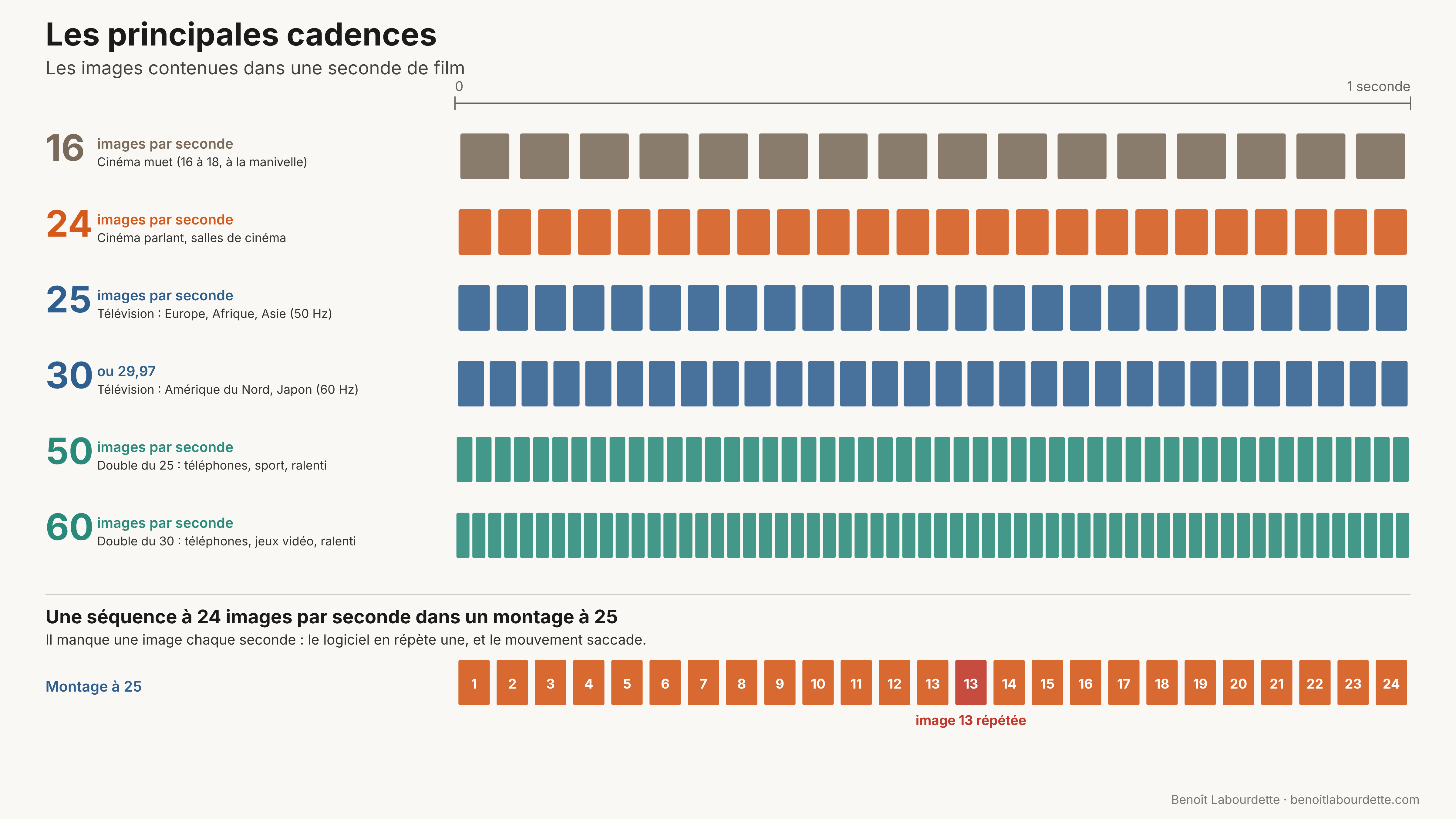
In the settings of a camera, a phone or editing software, you have to choose a number of frames per second: 24, 25, 30, 50, 60, and sometimes 29.97, which looks absurd. Which is the right one? None is better than the others. This diversity comes from the history of cinema and television, which I tell briefly, simplifying a little. What really matters is to keep the same frame rate from shooting to export, otherwise movements stutter, and that is very unpleasant to watch.
Still images, one after another
When we watch a film, there is no movement on the screen. There are still images, displayed one after another at a certain speed, and it is our brain that gives us the illusion of movement. I described this mechanism in Chapter 2 : Invention of cinema. At ten frames per second, you can clearly see that it is a series of photos; from about sixteen onwards, we believe in natural movement.
The number of frames per second goes by several names, depending on the software and devices:
- frame rate;
- “fréquence d’images” (image frequency) in French, as in the export menu of CapCut, a very simple editing application for phones;
- FPS, for frames per second, in the vocabulary of video games and a lot of software;
- “cadence” in French;
- and simply “frames per second”, sometimes abbreviated to “f/s”.
The main frame rates
Here are the ones we come across most often:
- 16 frames per second: silent cinema. In fact the speed varied, 16, 18, sometimes more, because cameras were hand-cranked.
- 24: talking pictures, from 1927 onwards. It is still the frame rate of cinemas.
- 25: television in Europe, and almost everywhere the electrical current is 50 hertz, in Africa, in much of Asia, in Australia.
- 30, or 29.97: television in the United States, Japan and part of Latin America, where the current is 60 hertz.
- 50 and 60: double 25 and 30, offered by many phones and cameras.
You also come across 23.976 and 59.94, American variants of 24 and 60.
A history of machines
Why did we go from 16 to 24? Before 1927, there was no sound in films. Sound was made live in the cinema, by an orchestra, by a narrator, or both. With talking pictures, sound was recorded on the film itself, on an optical track, and at 16 frames per second its quality was really poor. So the number of frames per second was increased to get better sound, with the techniques of the time.
And why 25 for television, and not 24? Television is a transmitter that sends images over the airwaves, and sets that receive them live, in people’s homes. The transmitter and the sets have to run at exactly the same rhythm, otherwise the images slip. Yet from the 1930s to the end of the 1960s, devices had no quartz clocks. The rhythm of the electrical current was used: in France, power stations produce a current that changes direction 50 times per second, very precisely, otherwise our washing machines and radios would not work. Television sent 50 half-images per second, the even lines then the odd lines, that is 25 complete images, as I explained in Chapter 4 : Interlaced video. It was the closest thing to 24 that could be found. I told this story in Chapter 3 : Technology of television.
When I was a child, in the 1970s, when you switched on a channel, the image was sometimes out of place, with a bar in the middle, and you had to turn a knob to set it right. Once set, the image stayed stable, but sometimes it slipped again. That knob has disappeared.
In the United States, the current is 60 hertz, hence 30 frames per second. But then, why 29.97? It is often attributed to the electrical current, but it comes from colour, which arrived in 1953 in the American NTSC standard. The colour signal mixed with the sound signal, and, so as not to force everyone to change their set, the image was slowed down by one thousandth: 30 divided by 1.001 gives 29.97. The engineer John Watkinson explains this in detail in the online journal The Broadcast Bridge, in 2021. In practice, 29.97 and 30 are almost identical.
What this history left behind
We have a stereotyped picture of silent cinema: whenever it is shown, everything goes at top speed, people run, jump, wave their arms about. Yet at the time these films were shot and shown, they were projected at their normal speed. But when cinema moved to 24 frames per second, from 1927 onwards, cinema projectors were set to that speed, and they could no longer be run at 16 or 18. The silent films that were part of catalogues, and which were still being shown, therefore ended up sped up, and then television broadcast them at 25. That is where the idea of a frantic silent cinema comes from. Today we can show them at their original speed, but they then seem strange to us, because we have always seen them sped up.
The same thing happens, to a much smaller degree, when you watch a cinema film on European television. Shot at 24 frames per second, it is broadcast at 25, and so slightly sped up: a film lasting an hour and a half is about three and a half minutes shorter. You do not notice it, because the difference is very small. But the sound changes pitch: on television it is higher by about three quarters of a semitone, and its pitch has to be lowered to get the original voices back.
Thanks to digital technology, we are now free of frame rate constraints. Our devices have quartz clocks, and projectors and screens adapt very well to all frame rates. In cinemas, which went digital around 2011, films can be projected at 24, 25, 30, and even 48, 50 or 60 frames per second, and a silent film can recover its original speed if it has been prepared for that. Everything could therefore be standardised. Yet we are still confronted with this history in the menus of our devices: depending on the phone, you find 24, 25, 30, 60, sometimes 29.97, and some do not offer 25. CapCut, on export, offers 24, 25, 30, 50 and 60.
A single frame rate per film
You might think that the frame rate does not matter, since there are enough frames per second anyway. But a video file has a single speed, which does not vary, and so does an edit: it is at 25, or at 30, but not both at once. If you filmed at 24 with your phone, or if several people gave you images at 25, at 30, at 60, the software has to adapt them:
- 24 in a 25 edit: one frame is repeated every second;
- 30 in a 25 edit: five frames are removed every second;
- 50 in a 25 edit, or 60 in a 30 edit: one frame in two is kept, regularly, and the movement stays smooth.
In the first two cases, the movement is no longer regular, it stutters. These stutters are more or less bothersome depending on the type of shot. A person speaking to camera without moving copes with them very well. But a tracking shot, a pan, someone walking through the frame become painful to watch.
The same problem arises on export. A collective film that I recently encoded so that it could be played over the internet had been edited at 25 frames per second. If I had exported it at 30, all the movements in the film would have stuttered, from beginning to end, and given the kind of film it was, it would have been very unpleasant to watch.
With CapCut, you do not notice it, because the application sets the project to match the first video you import, at least in the version I use. The following videos are then adapted to that frame rate, whether or not they were filmed that way. You can, however, choose the frame rate yourself when exporting, and that is where you need to check it.
Choose and stick to it
So here is my advice:
- Choose 25, 30 or 24 frames per second, it does not matter which, and stick to it from shooting to export. The projector or display screen will adapt.
- If your phone does not offer 25, shoot at 30 and edit at 30.
- If several people are filming for the same film, which often happens in workshops, give the instruction before shooting. It is much simpler than fixing the problem in editing.
- When someone gives you images at a different frame rate, it is not a disaster: you accept that one shot stutters a little, preferably a shot with little movement.
- Do a test before screening, by watching a shot with movement in it.
For cinemas, the DCP preferably takes 24 frames per second, but also 25 and 30, as I explained in Create a DCP for theatrical screening. So there is no reason to shoot at 24 “to make it look like cinema” if the rest of the chain is at 25.


