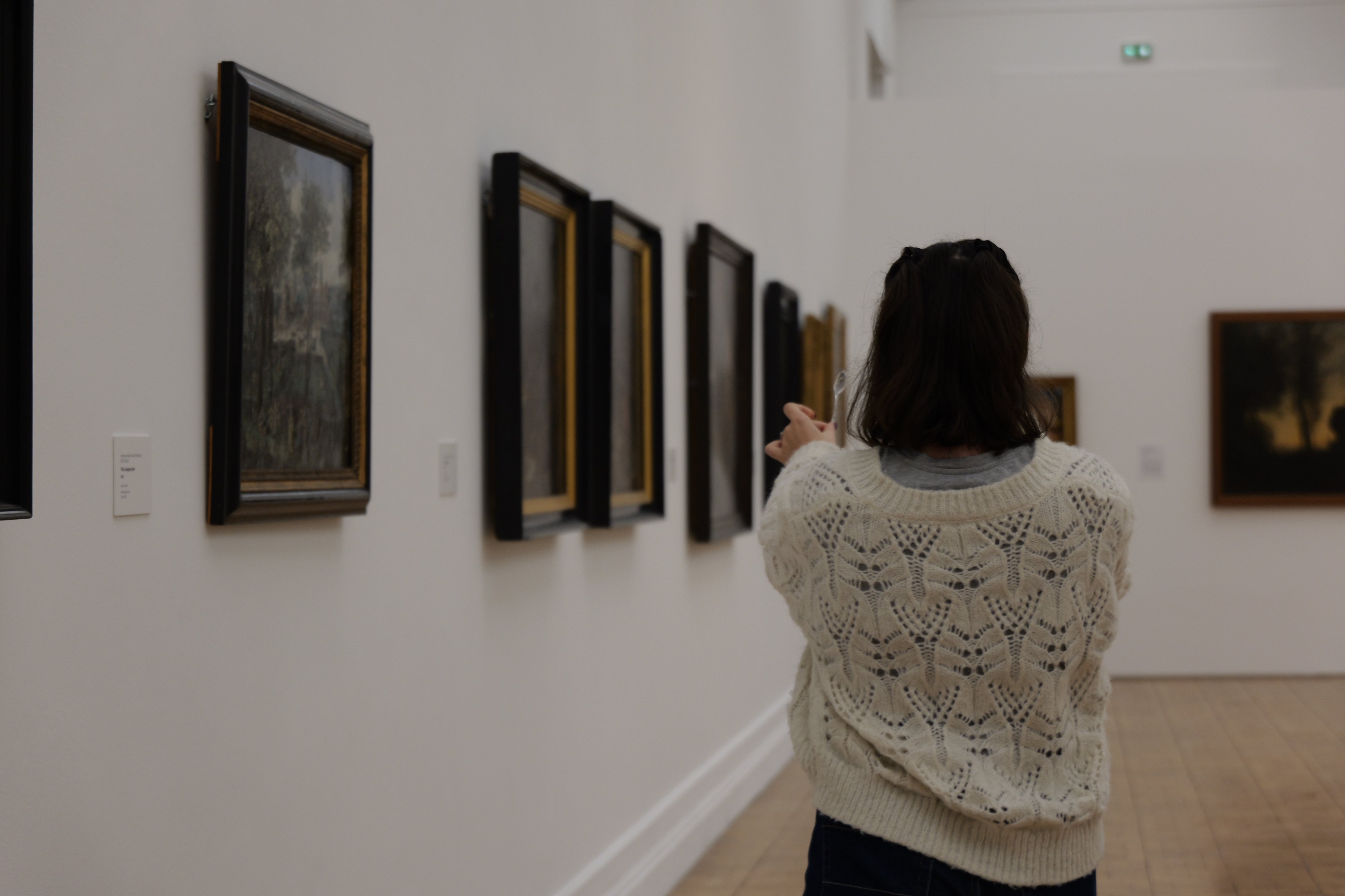
We tend to speak of the publics of a museum or a theatre as people who receive what is shown to them. Yet visiting an exhibition or attending a show means following codes (keeping quiet, keeping one’s distance, applauding at the right moment, etc.) that nobody states, and that many people therefore experience as imposed on them. Some are shared by almost every cultural venue, others are one person’s fear that has taken on the appearance of a rule. I suggest talking about them together while we are living them, so that visitors and spectators become a public in John Dewey’s sense: people who recognise that the same thing concerns them and start discussing it.
No eating in the gallery, no filming the cameras
Some time ago, I was leading a two-day workshop in a fine arts museum with students from a master’s programme in museology. When we arrived, the registrar gave us the house rules: no drinking or eating in the galleries, photographs without flash, and at noon the galleries are put under alarm. Later, a student asked her why we could not eat where we had set up. Her answer was precise: a room where people eat has to be cleaned every day, and the team cannot do it.
So we had been given the rules, and their reasons. An ordinary visitor receives neither. They walk in, and they have to guess.
While we were shooting a collective film, a student wanted to film the gallery’s surveillance cameras and give them a voice, speaking herself from behind the camera that was filming them. The attendant on duty told her the cameras could not be filmed, that this had to be checked with his manager, and that he made sure, besides, that visitors did not photograph them. I had never heard of this rule, and in that gallery any visitor can photograph whatever they like. Rather than wait for his manager, we put a camera on a chair, it stood in for the surveillance camera, and the film got made.
These codes have a history, too. Not so long ago, taking photographs was forbidden in most French museums, and this changed because museum professionals did a long piece of work so that visitors would have that freedom. These rules were decided by people, so they can be discussed. Still, one has to know that they are rules.
Codes that pass for the order of things
Why do we almost never discuss the codes, the roles and the positions of power in a cultural venue? The philosopher Giorgio Agamben offers a lead. He takes up Michel Foucault’s notion of the apparatus (dispositif) and widens it considerably. He calls an apparatus:
“anything that has in one way or another the capacity to capture, orient, determine, intercept, model, control and secure the gestures, behaviours, opinions and discourses of living beings. Not only prisons, then, asylums, the panopticon, schools, confession, factories, disciplines, juridical measures, whose connection with power is in a sense obvious, but also the pen, writing, literature, philosophy, agriculture, the cigarette, navigation, computers, mobile phones and, why not, language itself […].”
Giorgio Agamben, “What Is an Apparatus?”, 2006 (my translation from the French).
The museum where I was leading this workshop is one, with its visitor regulations, its galleries put under alarm at noon and its attendants. For Agamben, what we call a subject is born of the encounter between living beings and apparatuses. The “visitor” and the “spectator” therefore do not exist before the museum or the theatre; they are produced by them, at each visit and each performance. In The spectator’s score I described what is expected of a person in an auditorium, from the moment they arrive to the applause, and in The object that disposes the way objects arrange our bodies.
These codes have one particular feature: they do not present themselves as codes. They pass for the normal way of standing in front of a work, and that is why nobody questions them. Pierre Bourdieu and Alain Darbel showed this long ago, on the basis of surveys of visitors to European art museums. A taste for art presents itself as a gift, a natural sensibility, whereas it is learned, in the family and at school, and very differently depending on one’s social background. They draw a severe conclusion from this:
“If such is the function of culture, and if the love of art is indeed the mark of election separating, as if by an invisible and insurmountable barrier, those who are touched by it from those who have not received this grace, it is understandable that museums betray, in the smallest details of their morphology and their organisation, their true function, which is to reinforce in some the feeling of belonging and in others the feeling of exclusion.”
Pierre Bourdieu and Alain Darbel, “The Love of Art: European Art Museums and Their Public”, 1966 (my translation).
Raising your hand when you have finished
A person who grew up with these codes follows them without thinking. A person who does not know them often discovers them only by getting something wrong, like the student who wanted to film the cameras. They then experience them as something imposed on them, and often as a judgement on themselves, so that they have little energy left to encounter the work.
Social psychologists have measured this at school, and I presented their work in You are in a position of domination. Now what ?. In classes of ten- and eleven-year-olds, with more than a thousand pupils, it is enough to ask children to raise their hand when they have finished an exercise for the results of those from working-class backgrounds to drop. The children see who finished first, and those least used to school conclude that they are less gifted. Nobody notices this rule, and yet it weighs on what they manage to think, and on the idea they have of their own abilities. An imposed code often comes with shame. In Shame, the invisible emotion of the adolescent spectator I described how a person who feels ashamed must first defend themselves against what they feel, and is no longer available for what is being offered to them.
In the museum where I was leading this workshop, the students photographed the place from the angle of its accessibility. In one of the photographs, a body clings to a bench, against a background of floorboards and neutral grey. The group first saw someone crushed, who does not know where their place is in a museum and hides behind a piece of furniture. Then someone said the opposite: you are glad to find a seat, because it gives you time to look. Both readings are right, and this photograph says clearly what I am talking about here. A bench in an exhibition room serves for sitting down to look, or for taking shelter when you do not know how to behave, depending on who sits on it. I think the same goes for the codes of a cultural venue: the same code can help someone find their place or push them aside, depending on the function we give it and the way we talk about it.
An attendant’s fear taking the form of a rule
But are all codes of the same kind? I do not think so. Silence in the galleries, or keeping one’s distance from the works, are found in almost every museum; they have a history, and often a reason that can be given, as with the room where nobody eats. The rule about the cameras came, I think, from the attendant himself: the registrar had not mentioned it, and yet he presented it as a rule of the museum. In my view, it was his fear, which had settled into his function and taken on its authority.
For visitors, this is an abuse of power, and they feel it very clearly, even when they cannot put it into words. Is it the attendant’s fault? I do not think so: he was doing his job, with the information he had. But in the museum he occupies the place of a person who only does what he is asked to do, with no responsibility, and very, very little room for manœuvre. He did not write the regulations, and he is rarely asked what he thinks of them.
The work psychologist Yves Clot locates the origin of malaise at work in what he calls “impeded quality”, when one cannot do work one would be proud of, and in the disappearance of the places where people in the same trade discuss what good work is. I wrote about this in « So what do we offer them ? ». When those places are missing, what the attendant has left is his function, and he clings to it. The psychiatrist Jean Oury, who spent his life caring for the institution itself as much as for the people it received, described this mechanism as follows:
“Every responsible person must maintain the distance between ’status’, ’role’ and ’function’… That the nurse takes himself for ’the nurse’, the cook for ’the cook’ and the doctor for ’the doctor’ is, unfortunately, a worldwide disease! Everyone tends to identify with their ’status’.”
Jean Oury, “Psychanalyse, psychiatrie et psychothérapie institutionnelles”, 1993, reprinted in the journal VST, 2007 (my translation).
An attendant who takes himself for “the guard” can no longer say that he does not know. A problem in the organisation of work, which visitors do not see, thus becomes directly part of their experience of the place.
Saying “I don’t know”
What could the attendant have said? “I don’t know.” The decision belonged to his manager, as he had said himself, and he could have added why our request worried him. The request would have remained a question between people, instead of becoming a prohibition, and we might have learned something about what a surveillance attendant goes through when people film the cameras.
I try to do the same when I lead a group. I do not act as if what we are living were self-evident: I comment on it, and I talk about our roles. I sometimes say that a round of introductions is a ritual found in almost every professional meeting. I say that people are often afraid to express disagreement in a group, because they are afraid of being excluded from it, and that, since I am leading, it is also my role to welcome disagreement, even when it unsettles me, which is easier said than done. I also sometimes say that I feel like stepping in on what a group is doing, and that I hold back, because I would then be taking power over its expression.
By commenting, I do not remove any code. I make the codes visible, and I show that the person leading is caught in them too. Agamben calls profanation the act of returning to common use what an apparatus has captured and set apart. Commenting on the apparatus while we live it is, in my view, a modest form of it, within reach of anyone who welcomes a group.
Weaving rather than restating the rule
What should we do when a request unsettles us, when it questions our framework (filming a surveillance camera, sitting on the floor in front of a painting, talking during a screening)? Restating the rule ends the question, and everyone stays in their place. We can also decide some rules together. That is the intuition of institutional pedagogy, which Fernand Oury developed in cooperative classrooms. For him, “the simple rule that allows ten kids to use the soap without quarrelling is already an institution”, and he adds: “We call institutions what we institute together according to realities that are constantly changing” (my translation). The cooperative council is the place where these institutions are decided, and where everything can be called into question. In The framework that authorizes I described how I draw on it for the ephemeral institution a group gives itself for the time of a workshop.
But for a rule decided together to hold, something more than the decision is needed. What makes things common, I believe, is not the code: it is the weaving, that is, the fact that we are living something together, that there are codes that impose themselves, different places and roles, and that we have the right to talk about them. In Regulating the Regulators Too I described the way I weave during a training session: I comment on what we are living while we live it, I connect what has just happened to what happened before, and a discomfort to what caused it, making clear that these are hypotheses. I sometimes get the details wrong, but people understand that I am taking into account what they are living. Jean Oury said of the caring institution:
“What is most important is that there should be, there, in this place, a space for speaking, that there should be a possibility of expressing oneself, even if one says nothing; that there should be something there, a way of being at ease.”
Jean Oury, “Le Collectif. Le séminaire de Sainte-Anne”, 1986 (my translation).
In a museum, this space for speaking can be very small: an attendant who says why a request worries him, a mediator who announces at the start of the tour what is expected of visitors and why, a group that is asked what bothered it.
A public forms when people talk about what bothers them
The word “public” usually refers to the spectators and visitors of a venue. John Dewey gives it another meaning in The Public and Its Problems, published in 1927. For him, the public consists of everyone affected by the indirect consequences of actions they did not decide, to such an extent that it is deemed necessary to have those consequences systematically cared for. A public therefore does not exist in advance: it forms when people realise that something concerns them and start talking about it. Against those who wanted to entrust common affairs to experts, Dewey writes:
“The man who wears the shoe knows best that it pinches and where it pinches, even if the expert shoemaker is the best judge of how the trouble is to be remedied.”
John Dewey, “The Public and Its Problems”, 1927.
People who visit a museum or attend a show know very well where the codes pinch. Teams often know how to remedy this, or can learn. Visitors and spectators become a public, in Dewey’s sense, when the two talk to each other. In Inquiring in the spirit of cultural rights I presented what this idea changes in the way an inquiry is conducted, and in John Dewey : an inspirer of cultural rights ? its kinship with cultural democracy.
Should we then give up the guided tour, the label or the lecture? No, of course not. A classic tour, with one person telling and others listening, goes very well when people have been able, beforehand, to make their own what is expected of them. I have two examples. In one museum, visitors had made animated films based on an exhibition about prejudice and racism, and these films were screened during a guided tour, in the middle of the galleries. Elsewhere, primary school pupils themselves led three tours of their own exhibition in two days, which I recounted in Where rigor belongs. In both cases the tour kept its usual form, but the visitors, or the pupils, had at some point been the ones giving the tour.
Five questions before welcoming a group
I ask myself these questions when I prepare to welcome a group that does not know the venue, and I suggest you ask them too:
- What are the codes of what we are going to offer (the timetable, silence, distance from the works, photography, the way to ask a question, etc.), and which of them are stated anywhere?
- For each of them, can we give a reason, like the cleaning of a room where people eat? If not, is it a habit, or someone’s fear?
- Who in the team will be facing the visitors, and is that person allowed to say “I don’t know, I’ll ask”, and to say what worries them?
- At what point will we talk together about what we are living, about everyone’s places and roles, including mine?
- What will the people we welcome be able to change, in the venue or in the visit, if they ask?
I find the last question the hardest, because it concerns the venue itself and not only its mediation. If nothing can move in a venue, it is the people who know its codes least who make the most effort to adapt to it, and they are often the ones described as “hard-to-reach” publics.


