A cultural mediation project is done for the people who take part in it. They are the ones who should benefit from it as much as possible, and the institution that carries it is itself at the service of citizens. We know this, but we easily forget it along the way. When I arrive at a workshop, I have a project in mind, a theme, a form, an idea of what we are going to make and how we are going to show it, and the funding bodies have their own objectives too. The participants, in fact, do not always know what they want. They discover it by doing, because what is offered to them meets their own concerns, and what then turns out to matter to them is not necessarily what the person leading the workshop or the institution had planned. It is this gap, I believe, that lies at the heart of mediation work.
Who do we do this work for?
The words are not very clear, it has to be said. In project files, we write “audiences”, as if they were spectators to whom something is shown, or “beneficiaries”, which is more accurate, since it is for them that we work, but which turns them into people who receive. In this article, I say participants, to speak of the children, adults, families and groups who come to the workshop, because the more you can bring something to a project, the more you benefit from it.
One might think that the person leading a workshop must hold their course. They were brought in for their know-how, they have high standards, and if they follow every suggestion, the project gets diluted. I sometimes think so myself, and hold my course. But there is an idea here that seems wrong to me, which is that there would be only one subject in the workshop, theirs, and that everything else would be a deviation.
In fact, very often, over the course of the workshop, something takes on importance for the participants, something they did not know when they arrived, and which matters as much as the subject of the person leading. And if we do not see it, people do what they are asked, sometimes very well, but the project remains someone else’s, and they carry it out more than they take part in it. In Letting Go of One’s Criteria, I explained that I have to give up my own criteria of judgement in order to see people’s productions as they are. This is about what comes before: the starting point itself. What are we talking about, what matters to us today, where do we begin: we have to accept asking these questions together, even when we arrived with our answers, and even when the institution already had its own. At such moments, it seems to me that we need to return to the fundamentals, to the reasons why we do this work, that is, to the participants.
This is also what cultural rights call for. The Fribourg Declaration, written in 2007 by experts gathered around Patrice Meyer-Bisch, speaks of everyone’s right to take part in cultural life, not only to have access to it. And taking part, in the strong sense, means being able to weigh on what is done, including the subject.
Starting from people’s view of the world
Paulo Freire, the Brazilian educator, worked a great deal on this question. In Brazil, in the early 1960s, when he was teaching adults to read, he did not start from a textbook, he started from the words they used in their work, in their everyday life, and more broadly from what concerned them. He called these generative themes. He writes in Pedagogy of the Oppressed, in 1968:
“It is to the reality which mediates men, and to the perception of that reality held by educators and people, that we must go to find the program content of education. […] It is not our role to speak to the people about our own view of the world, nor to attempt to impose that view on them, but rather to dialogue with the people about their view and ours.”
Paulo Freire, “Pedagogy of the Oppressed”, 1968.
So the educator keeps their view of the world, but puts it in dialogue with that of the people, instead of making it the only starting point.
Jacques Rancière goes further, in The Ignorant Schoolmaster, in 1987. He shows that the knowledge of the one who explains is not neutral, and that it sets up a hierarchy even before the explanation begins:
“To explain something to someone is first of all to show him he cannot understand it by himself. Before being the act of the pedagogue, explication is the myth of pedagogy, the parable of a world divided into knowing minds and ignorant ones, ripe minds and immature ones, the capable and the incapable, the intelligent and the stupid.”
Jacques Rancière, “The Ignorant Schoolmaster”, 1987 (my translation from the French).
I believe it is the same for the subject of a workshop. If I impose mine, I let people understand, without saying it, that what occupies them matters less than what occupies me.
The philosopher Joëlle Zask, in Participer, in 2011, distinguishes three ways of participating: taking part in something that already exists, bringing one’s part to it, and receiving a part of it. In cultural projects, we mostly offer the first: we invite people to take part in a workshop whose theme, form and final presentation are already fixed. Bringing one’s part is harder to welcome, because what people bring changes the project. But that is where, in my view, mediation becomes work done together.
Eighty panels and gaffer tape
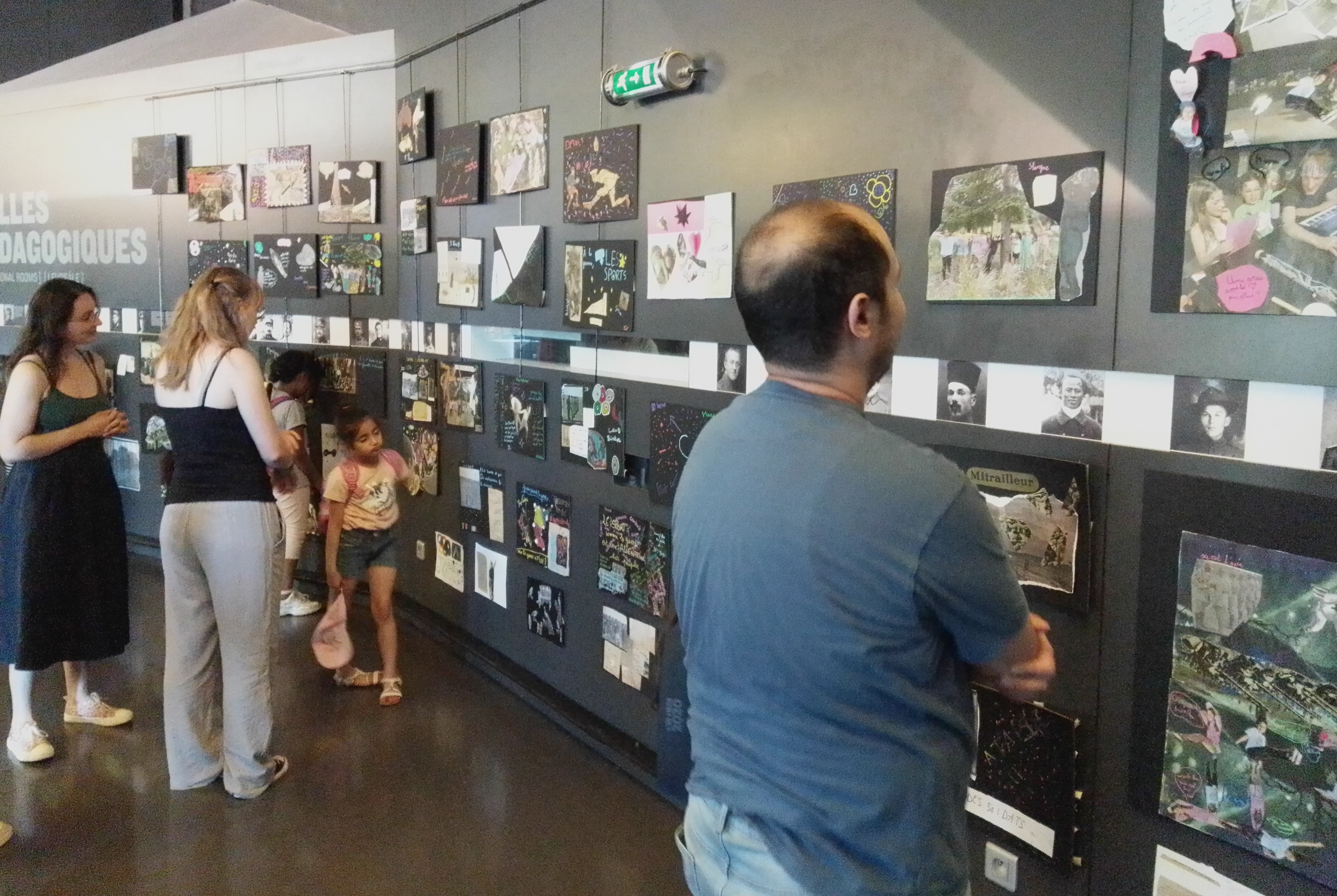
In the summer of 2024, for three weeks, I led collage workshops for the Musée de la Grande Guerre in Meaux, as part of the “C’est mon patrimoine” programme. It was the summer of the Olympic Games, and the theme was sport during the First World War. The participants, many of them children, cut up photographic archives from the ECPAD to make collages, which were going to be exhibited in the museum. I described the whole project in Memory of sport in the Great War, participative creation of a photographic exhibition.
I had planned a dozen large panels. There were eighty, because some people spent hours on a collage, and others went much faster. On the day of the opening, the participants were invited an hour and a half before it began, to hang their works themselves. I was keen for them to be the ones putting them on the wall. I also had in mind that we would think together about the composition, which panel next to which, which colours answer each other, and this is a point I care about a great deal.
The children were not interested in this at all. They had seen that the panels were not holding well on the picture rails, and they knew the exhibition was to stay in the museum until 11 November. Their subject was making sure it stayed on the wall. For an hour and a half, I cut pieces of gaffer tape, the cloth adhesive tape used in theatre, which I gave them double-sided, and at each panel we asked ourselves whether it was holding properly. Nothing fell down before 11 November.
At the time, I could have imposed my idea. I know how to do it, and I would have felt entitled to: I am an artist, and composing a hang is part of my profession. I chose to start from their starting point. It was not to dismiss aesthetics, which we could have discussed afterwards, and in fact they changed a few small things in the layout. But through this concern for solidity, I saw something else: they felt responsible for what was on the wall. They were bringing their part, in Joëlle Zask’s sense, and the exhibition became theirs. Some of them went back to see it afterwards. In the article where I told the story of this project, at the time, I wrote that they had brought me back to reality, which is multiple, and that I had learned that there is no essential, only complementarities.
When nobody comes
On the first day of these same workshops, there was nobody. The leisure centre that was supposed to come had cancelled the week before, following one of those organisational problems that exist in every local authority. The workshop was held in one of the town’s performance venues, the espace Caravelle, from which the seating had been removed.
It has often happened to me, arriving somewhere and finding nobody. You can take it as an affront, and I know artists who experience it that way. I take it rather as an opportunity to go and see who is there. In Meaux, there was a media library in the same building. We went to see the team, who told the people passing through about the workshop. The next day, a neighbourhood party was taking place just behind, and we took our papers outside. It was windy, the papers were flying everywhere, and we met people we would never have reached otherwise. Some, who came by chance, spent whole days in the workshop.
That day, for lack of the planned group, we started from the neighbourhood. I am not saying we should rejoice at things going wrong. I am saying that the workshop is made for the people who are there, including those we were not expecting, and that this is also a way of making it accessible.
A youth worker who wanted to take photographs
In the summer of 2023, I was leading workshops with Cultures du cœur in eight social organisations, on the theme of the future; I described this in Cultural summer 2023 with Cultures du cœur : « The machine that travels into the future ». One of these days took place with a second-chance school near Blois, in a half-abandoned industrial zone. It was raining, and the place was magnificent. A youth worker from the association arrived saying she really wanted to take photographs in this place. I replied: very well, you will lead a photography workshop for the participants. She was surprised, and I confirmed.
I have been taking photographs myself for a long time, and I could have told myself that it was up to me to say how to take a good photo. But the subject of that day was for people to make something, and this youth worker had a desire she could share. So the starting point can also come from a colleague. I described in The artist as guarantor this position in which one makes possible what others create, without doing it in their place, and it also applies between professionals.
Subjects that complement each other
In these three situations, I did not abandon my project. In Meaux, the exhibition did take place, with the archives, the collages, the opening, and in Blois the day kept its theme. Only the starting point moved. If I was able to let myself be moved, it is because around it there were things that did not move: in Meaux, the tables covered with archives, the room, the three weeks, and the commitment that everything people made would be exhibited. That protects me, and it also protects the participants. I devoted an article to this framework, The framework that authorizes.
But it has to be said, these choices have a cost, and when we tell them afterwards, we do not see it. At the time, it touches on professional identity. In Meaux, it touched me. Giving up composing a hang, when that is your profession, means accepting not to show your knowledge. Rancière puts it well: as long as I show my knowledge, I remind others that they do not have it. When I set it aside, the children’s question, making sure it stays up, becomes as legitimate as mine, and we realise the two are not opposed at all. Solidity and aesthetics complemented each other, and the exhibition needed both.
A few methodological gestures
In practice, what I try to do is first not to forget, and to remind the institution when necessary, who the project is for. I arrive with mine, I say so, but I do not treat it as the only possible starting point, and during the workshop I watch what the participants do without being asked, like those children who went from one panel to the next to check it was holding. I also always bring much more material than is necessary, because you never know what will be used. In Meaux, for example, I had not brought the Posca markers on the first day, I brought them on the second, and in fact they were used a great deal to work on the photos, which I had not anticipated at all. When the planned group does not come, I go out, I go and see who is there, and when a colleague has a desire that can be shared, I let them take over.
Before deciding, I ask myself a question: what turns out to matter to the participants, is it contrary to what we came to do together, or is it simply different from what I had planned? If it is simply different, which is most often the case, we can start from there, and come back to our own idea later.


