In care and support institutions, the roles of caregiver and cared-for organise every hour of the day. A creative workshop can bracket these roles for the length of a session, provided this bracketing has been built beforehand with the team. I propose to call this work the suspension of places, and to draw concrete methods from it.
Places are distributed before the workshop begins
A care institution distributes places. There are the people who lift, wash, dress, carry, and the people who are lifted, washed, dressed, carried. There is nothing malevolent about this distribution; it is what allows daily life to function, and the teams have no leisure to question it at every wash. Yet it has an effect the institution no longer sees, because it has become the air it breathes. By dint of being, day after day, the object of other people’s gestures, a person ends up existing in the establishment’s eyes only as a body being taken care of.
In the article Place as an Operative Concept for an Emancipatory Cultural Mediation, I proposed thinking of place not as a position to occupy but as a capacity to move within a relational and symbolic space. I was looking mainly at what assignments do to people, and at how a symbolic third party gives them back some movement. Here I would like to look at the other, collective side. How can a workshop be designed so that, while it lasts, the places distributed by the institution cease to govern the relationship? For if the professionals supervise while the people do the activity, the workshop re-enacts the ordinary order, and mediation takes place inside the very thing it meant to displace.
From the phone you own to the role you occupy
In the article The object that disposes, I described how the choice of equipment positions people in relation to one another. A facilitator who arrives with a professional camera that only he knows how to use places the participants in the position of apprentices before he has said a word. When you work with everyone’s own phones, everyone owns their tool and knows it, and nobody needs to be shown how to use it.
That analysis was about objects. In care and support institutions, the same question arises for roles, and it arises there with even greater force, because roles are embodied far more deeply than tools. What decides the nature of what is going to happen comes down to one question. What do the professionals who support the people day by day do during the workshop?
The suspension of places
Anthropology has closely studied social devices whose very function is to render places inoperative for a bounded time. Arnold van Gennep, in The Rites of Passage (1909), showed that rituals of status change include a phase of margin, in which the person no longer belongs to their former state and does not yet belong to the new one. Victor Turner, in The Ritual Process: Structure and Anti-Structure (1969), devoted his attention to this phase, which he calls liminal. Ordinary hierarchies have no effect there, and what forms there is what Turner calls communitas, a community of equals that can only exist within a framed time and then returns to social structure. Turner makes a point that seems essential to me for our practices. Communitas does not replace structure and does not seek to replace it; it lives on its contrast with structure, and societies set aside bounded ritual times for it precisely because it cannot last.
A creative workshop is not a ritual, but it can have a ritual’s architecture: a bounded time, an explicit frame, and within that frame, statutory places rendered inoperative. I long described this as a symmetry, and the word bothers me today, because it suggests a real equality. Joan Tronto, in Moral Boundaries. A Political Argument for an Ethic of Care (1993), reminds us that the care relationship is structurally asymmetrical, that the one who gives care and the one who receives it are not interchangeable, and that any thinking about care begins by facing this asymmetry instead of covering it over with good feelings. A care assistant who dances with a person with profound multiple disabilities goes home in the evening; the other does not. The workshop abolishes none of this, and it would be lying if it claimed to.
This is why I propose to speak of a suspension of places. The word names a deliberate act, it names a bounded time, and it claims to abolish nothing. One suspends a rule without deleting it; it will take effect again at the end of the session, and everyone knows it. This lucidity makes the arrangement workable. A team will agree to play the game of an hour without places precisely because nobody is asking it to believe in it beyond that hour.
Institutional psychotherapy attempted the same operation on the scale of the whole institution. In the article The One Who Makes Nothing, I recounted how François Tosquelles at Saint-Alban, then Jean Oury at La Borde, made tasks and roles circulate between caregivers and cared-for, permanently and for everyone. The workshop suspension does on the scale of an hour what those places did on the scale of an institutional life. This modesty is also what makes it possible in establishments where a permanent transformation is out of reach.
Support workers who dance
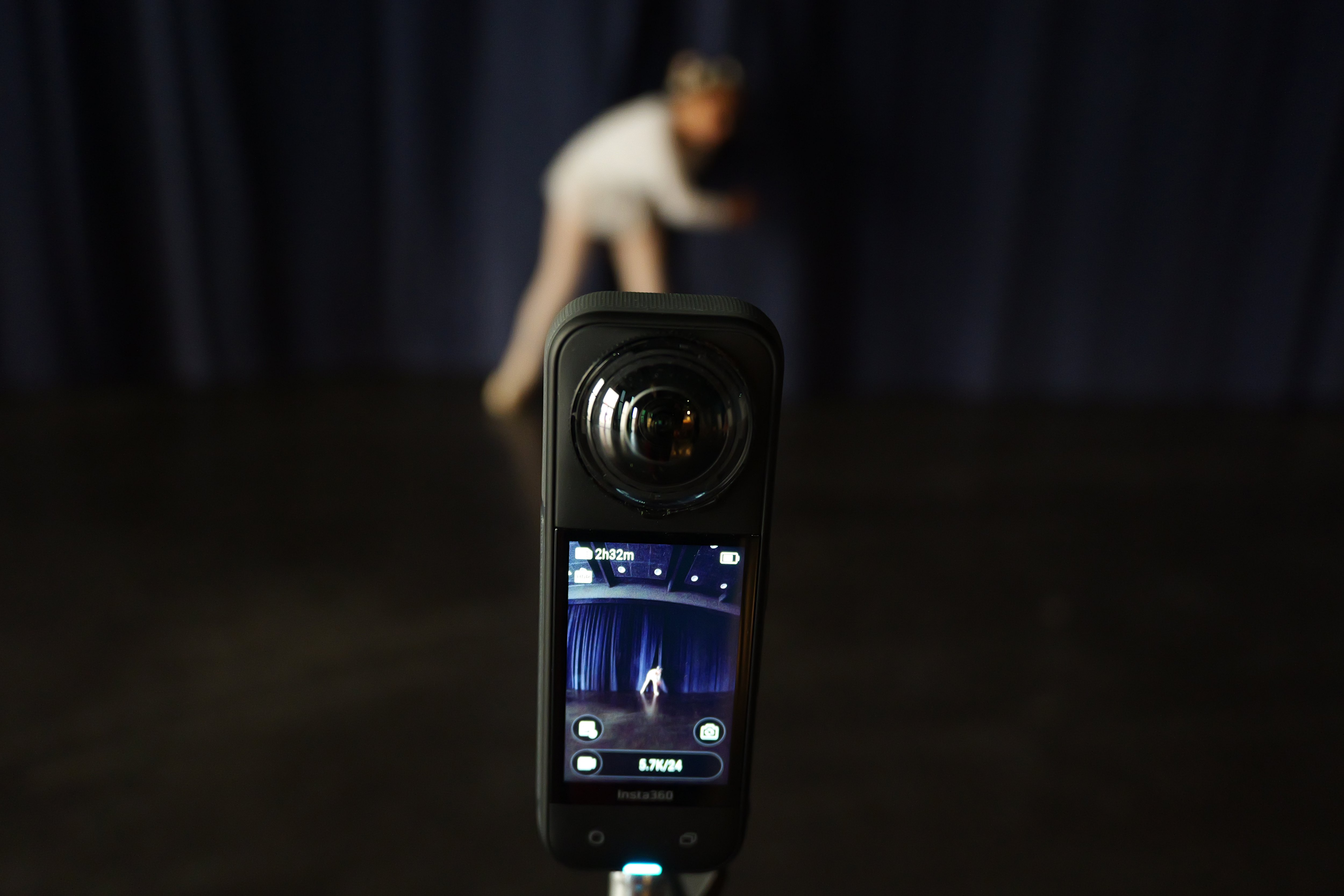
In a specialised residential care home live people with profound multiple disabilities. Their daily life is made of handling. In the morning they are lifted, washed, dressed; meals are assisted; moving about is done by others. A dance workshop opens in this establishment. The question that decides everything is not the choreography or the music; it is the one I asked above. What do the support workers do during the session?
If they support the gesture, carry, watch over, then the people are not dancers; they are cared-for people being made to do an activity, and the body remains a handled body, with music added. If, on the other hand, the support workers are dancers too, if they explore their own kinesphere, that sphere of movement around the body described by Rudolf Laban, if they know no better than the others what should be done, then the relationship changes in nature for the length of the session. The woman who, the day before, carried this body is today just as much a beginner as they are. She has no knowledge to pass on; she has an experience to go through, the same one. And the person being supported ceases to be the object of the other’s gesture.
This shift is not a matter of a nuance in individual posture; it is a matter of how the workshop is set up, and it is built before the workshop, with the team, against the establishment’s ordinary slope. It requires in particular that the support workers commit voluntarily, and not that they be assigned, because a professional who is there because she was put there is not in the same situation as a person who chose to come and dance.
Discovering one’s own clumsiness before the people one supports
There is a point I have not seen written anywhere and which seems decisive to me. This suspension also acts, and perhaps above all, on the professionals.
When I run a workshop in an institution and ask the teams to make things with us, the first reaction is almost always a movement of recoil. They have no time, they have to supervise, they don’t know how, it is not their place. And when they finally join in, something shifts that I do not yet know how to name properly. They discover the people they support differently, because they are no longer in the act of supporting them. They discover themselves clumsy, hesitant, creative, in front of these people, which never happens to them in the ordinary course of their work.
I have often heard teams say that they no longer looked at someone in the same way after seeing that person do something they themselves did not know how to do. Victor Turner noted that people who have gone through a liminal phase together keep bonds that persist once structure returns, and I hypothesise that something analogous is at play here. The suspension ends, the roles resume, but the gaze does not return exactly to its starting point. I observe it; I cannot yet explain it, nor say how long it holds.
The question to ask the host institution
What I retain for practice comes down to a few things, and they are decided ahead of the workshop. When I prepare an intervention with an establishment, I propose adding to the usual questions, space, equipment, audience, a few questions that bear on places:
- What will the professionals who support the people day by day do during the workshop? If the answer is that they will support, the workshop will re-enact the places.
- Has their participation been offered to them, with a real possibility of declining? A prescribed participation would re-enact, at the team level, the very hierarchy it claims to suspend.
- Does management recognise this participation time as working time? Without this validation, the suspension rests on people’s goodwill alone, and it will not survive the first scheduling problem.
- Do the equipment and the space ensure that nobody starts with a head start? This is the material side of the same question, that of the object that disposes.
These questions are not a matter of the teams’ goodwill, which is almost always there. They are a matter of building the whole arrangement, which takes preparation time, meetings, management’s agreement. It is work, and it is done before the first person walks into the room.


