A website belongs to the realm of the archive, a living archive that grows richer with every page and can still be consulted ten years later; social networks belong to the flow, and serve to make known what the website contains. Here I bring together a few guidelines: the objectives of the one and of the others, the technical conditions for long-term preservation, the place of narratives, three questions to ask yourself before writing, priorities when resources are scarce, and a simple way to check that the website is useful.
An association, a company, a network, a theater company: the same need for a website
Do you still need a website when you have a Facebook page, an Instagram account and a WhatsApp group? Yes, whatever the organization. An association that welcomes the public, a small business, a network of organizations, an amateur theater company that performs two shows a year, a festival, a cultural venue, etc.: all of them have information that must be authoritative, a history to keep, and people looking for them who do not know them yet.
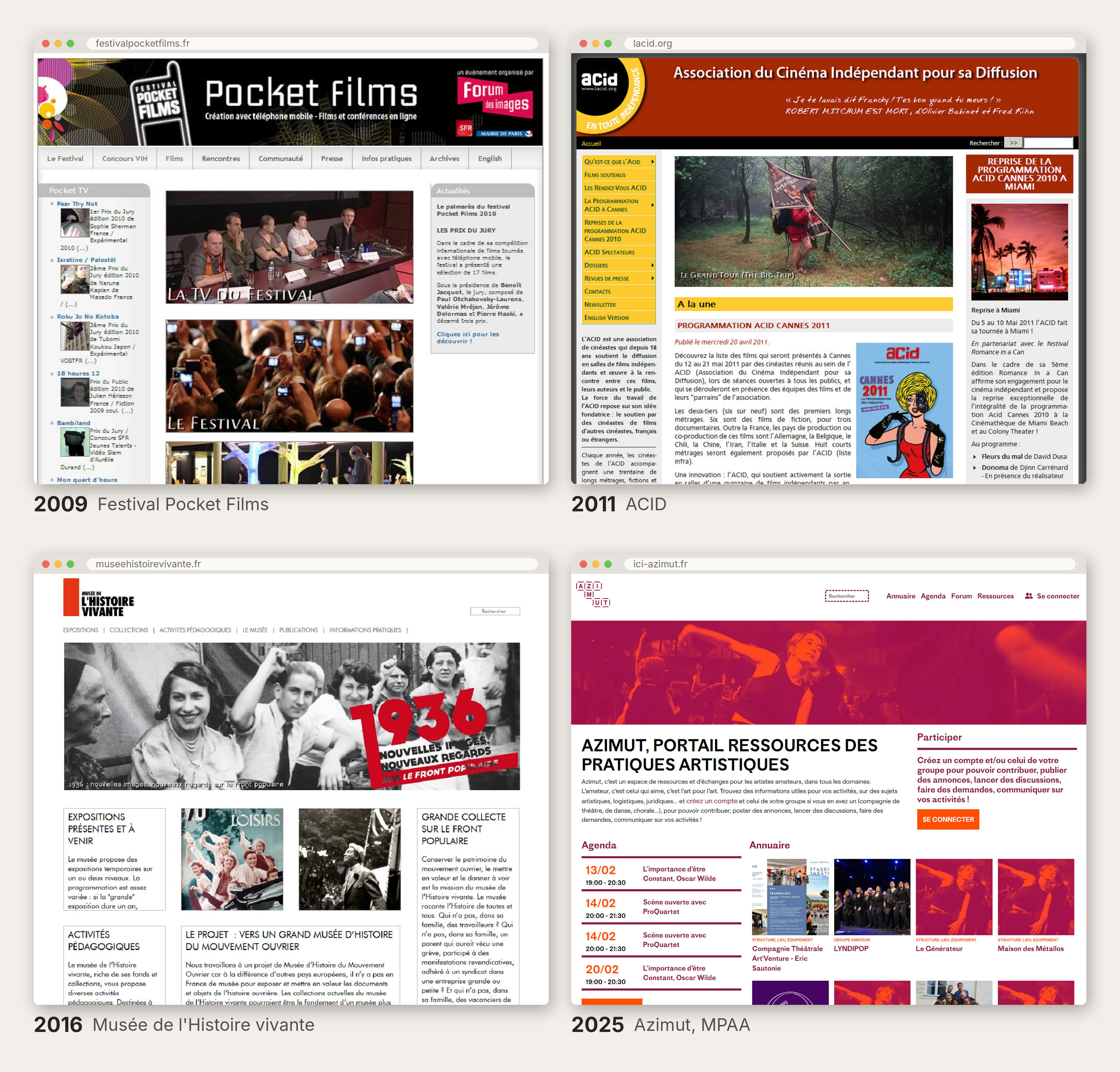
I have built websites for very different organizations. For ACID, the filmmakers’ association that has supported the theatrical release of independent films since 1992, I redesigned the website and built the databases (films, selections, contacts). For the Museum for Living History in Montreuil, opened in 1939 and dedicated to the history of the labor movement, I rebuilt in 2016 a very rich static website that no one could develop any further. For the Maison des pratiques artistiques amateurs in Paris, I designed Azimut, the platform for amateur artistic practices. Their initial needs were not alike. One question applies to all of them, though: what do we expect from the website, and what do we expect from social networks?
The objectives of the website, the objectives of social networks
I distinguish between content and communication. Content means information, resources and narratives, organized, that can be found, consulted and cited long after they were published. Communication is the way this content reaches people. Content belongs on the website; communication goes through social networks and the newsletter. In 2025, in Cultural venues and social networks, I wrote: “The website is not a communication tool but a source.”
Here is the difference, in summary:
| Website | Social networks | |
|---|---|---|
| Lifespan | pages that can be consulted for years, at the same address | posts that disappear from view after a few hours or a few weeks |
| Organization | sections, keywords, links between pages, an internal search engine | a chronological feed |
| Length | articles as long as needed, with images, sounds, videos and documents | a few lines (2,200 characters at most for an Instagram caption) |
| Access | through a search engine, an artificial intelligence assistant, a link | through subscription, and according to the platform’s ranking choices |
| Rules | set by the organization | set by the company that owns the platform, which can change them |
| Content | reference information, history, narratives, resources | announcements, reminders, links back to the website, conversation |
So I suggest a working rule: write on the website, then relay on social networks, with a link to the page. In Rethinking the digital content strategy of cultural institutions, I describe this movement for cultural venues, from the in-depth article to the excerpts published on social networks. Yet we very often do the opposite. We post the photos of an event or the report on a workshop on Instagram, and never put them on the website, which remains a frozen shop window. You can also choose not to be on a network, when you do not know what you want to do there, provided you accept the consequences (Social Networks and Cultural Institutions : Breaking the Strategic Deadlock).
Reference information: opening hours, prices, statutes, documents
The website is the official source of an organization’s information. That is where you find the opening hours, the address, the prices, the conditions for admission or registration, the statutes, the activity reports, the documents to download, etc. It is the place you send partners, journalists, customers and the people you welcome. And it is the place you correct when a piece of information is circulating inaccurately elsewhere. In Cultural venues and social networks, I wrote: “A collective institution needs an official space, repository of authentic information.”
This information is corrected on the very day it changes. Someone who made a trip for nothing because of outdated opening hours will no longer trust the website. And the page now serves readers other than humans: when someone asks an artificial intelligence assistant about your organization, the answer is written from the pages the robots have collected; if yours is missing or out of date, it is written from other pages. I explain this mechanism in Being read by artificial intelligence: how an association’s visibility is changing.
A living archive, written to be read in ten years
A website belongs less to the present than to the archive. Each page published adds to the previous ones, keeps its address, its date, its section, and can be found years later by someone looking for exactly that. “The living archive” is the title of a podcast I recorded in 2023 for the conference “Cliquer l’archive” at the École des Beaux-Arts in Paris. By this I mean an archive that we keep enriching, linking and making accessible, and that serves the life of the organization. In Social Networks and Cultural Institutions : Breaking the Strategic Deadlock, I drew the consequence for a cultural venue: if the goal is to build “a living archive of the cultural life of the place”, the institutional website remains the most suitable tool, “sustainable, controlled, searchable”.
This archive is also constructive, in the sense that it then serves to feed other tools, starting with search engines and artificial intelligence. Search engines index its pages. Artificial intelligence models are trained on texts collected from the web, and, when a question is put to an assistant, pages are downloaded to write the answer. An organization that has been recounting its work precisely for years becomes part of what these tools later give back; in Should We Feed Artificial Intelligences ?, I defended the need to keep feeding them with human production.
The risk, for a digital archive, is disappearing. In Our fragile memory, I took the example of a music festival: when the local authorities stop funding it, when the association that organizes it disappears and no one pays for the hosting any longer, the website closes, and “extremely few traces will remain”. The Bibliothèque nationale de France collects part of the French web as legal deposit, under the law of August 1, 2006, but by sampling: one broad crawl a year, supplemented by targeted crawls, which amounted to 5.8 million domains in 2022, about 60% of the French web according to the BnF. For everything else, preservation depends on the organization itself. By contrast, the website of the Pocket Films Festival, which I founded in 2005 with the Forum des images, stayed online after the festival ended in 2010, with more than 350 films (www.festivalpocketfilms.fr website).
For a website to remain a living archive, I suggest a few technical rules:
- Keep the same addresses. When a page changes address, all the links that led to it are broken, from other websites, emails, files, search engine results. During a redesign, redirects are set up from the old address to the new one. For the Museum for Living History, the challenge of the 2016 redesign was that “the old content is not lost (as happens often in the redesigns...)”.
- Date every page and file it. A visible date, a section, keywords and links to neighboring pages make it possible to find your way through hundreds of articles, for people as well as for robots.
- Keep past content online. A completed edition, a finished project, a former team remain available, in an archive section if need be.
- Back up, away from the web host. The website’s files and database are copied regularly, and you check that you know how to put them back online (The Strasbourg fire and the three-copy rule: backing up your association’s website and knowing how to restore it).
- Renew the domain name, and keep it in the organization’s name. A domain name that you forget to renew can be bought by someone else, and the website disappears along with its links (Domain name, web host, online platform: who owns your association’s website?).
- Choose a tool you can leave with your content. Free software installed on a web host lets you export your articles and change tools without retyping everything (WordPress, SPIP, Joomla, Drupal or a static site: choosing a website tool according to your real needs).
Without narratives, an organization does not exist on the web
In my view, without narratives and without history, an organization does not exist for the people who have not experienced it from the inside. The account of a workshop, a tour, a building project, a meeting, with its dates, its places, its photos and the words of the people who took part, is part of its identity. So is the history of the organization: its founding, its stages, the people who carried it, the projects that mattered, etc. In Rethinking the digital content strategy of cultural institutions, I described these narratives as “the written narrative of the territory, which anchors itself beyond individual memories”, and added: “It’s the transition from orality to writing.”
Social networks do not allow for these narratives. A narrative needs space, a text that unfolds, many images, and an address where it can be found again. On a social network, a post holds a few lines, it slides down the feed, and it is hard to find three years later. For an event, twenty-five photographs published on the website are better than three, as I wrote in Cultural venues and social networks.
Who reads these narratives? People who are hesitating to come, and who want to see what it is like. Partners and funders, who want to understand a way of working. New members, volunteers or employees, who discover what was done before them. Journalists, researchers, students. And search engines and artificial intelligence, which collect these texts and later pass them on to others.
A stable address, text and links, which search engines index
A search engine like Google works in three stages. Programs called robots browse the web by following links from one page to another. The text of the pages collected is stored in a huge index. When someone types a search, the engine ranks the pages in the index that match it. I describe how this works in Robots, index and PageRank: how a search engine works, and why nobody is “number one on Google”.
A website page lends itself well to this mechanism. It has a stable address, which can be cited, sent, put in a file, and to which other websites link, and these links count in its ranking. It is made of text, with a title and subheadings. It is linked to the other pages of the website. Social network posts lend themselves to it much less: many are only displayed to people logged in to an account, and their text is limited to a few lines. Since July 2025, Instagram has allowed search engines to index some of the public photos and videos of its accounts; but it was the company that decided this, and it can go back on that choice.
For your organization to be found on a precise search (a video workshop for teenagers in a given neighborhood, a vegetarian caterer in Lille, a troupe recruiting amateur actors), you therefore have every reason to publish precise pages on your website, each on one subject, with the words used by the people searching. I develop this point in Being found by those who are looking for you: niches, the long tail and precise queries and in Keywords without losing your voice: writing with the words of the people concerned. Search engines index text first: the program on a poster published as an image, or what is said in a video, are worth writing out on the page as well (An image only exists on the web through the text written for it: alt, caption, transcript, subtitles).
Why, for whom, how: three questions to ask before each page
Before writing a page, I suggest you ask yourself three questions:
- Why am I writing this page? What am I offering someone by publishing it: practical information, a resource, the account of an action, a piece of the organization’s history, a procedure made easier?
- Who am I writing it for? Who is going to read it, with what expectations, with what words, knowing what about the subject?
- How am I going to write it and make it known? In what form (an article, a practical page, a document to download), with what images, and through which relay (a social network, the newsletter, a partner)?
For the second question, you can use the persona method, which Alan Cooper popularized in 1999 in The Inmates Are Running the Asylum: you put yourself in the shoes of a few typical people, fictional but plausible. For an association, I suggest imagining three: a partner who funds it, a beneficiary, a member. For an amateur theater company, they will rather be a spectator, someone who would like to join the troupe, and the town hall that lends the venue. For a company, a customer, a partner, a future employee. Their expectations are not alike, and you sometimes discover that you need two pages where you had planned one.
Write the answers to the first two questions at the top of your draft, or in a comment in the page’s code, which visitors do not see (Ctrl+U: viewing a web page’s source code to see it as search engines receive it). You will keep them in front of you while you write. And look at what neighboring organizations publish: by typing the words of your field into a search engine, you will see what only you can write, very often a place, a neighborhood, a way of doing things, a history.
With few resources, up-to-date information and one narrative per action
When an organization has neither a communications officer nor a budget for its website, I suggest sticking to a few priorities, in this order:
- Keep the pages people come looking for up to date. Who you are, what you do, where and when, how to reach you, how much it costs.
- Tell the story of each action, even briefly. Three paragraphs, a date and a dozen photos taken by the team already make a narrative. A photo you took yourself, even an imperfect one, is better than a stock image already seen on ten other websites.
- Write once, publish on the website, then relay. The same text, shortened, becomes the social network post or the newsletter item, with the link to the article.
- Reuse what you already write. Activity reports, minutes, grant applications and show programs contain narratives and presentations that can be published, adapted to the people who will read the website.
- Choose a pace you can sustain. Better to publish one article a month for years than a series of quick posts abandoned after three months.
- Make sure at least two people know how to publish. If only one person knows how to update the website, everything stops when they leave.
- Choose free and inexpensive tools. Free software such as SPIP or WordPress costs nothing, and you install it on a web host for about a hundred euros a year. You can also use artificial intelligence for certain tasks, without handing over the writing (Using artificial intelligence for your association’s website without handing over your voice).
Knowing whether the website is useful, through conversations rather than a questionnaire
Without evaluation, you do not know whether the effort put into the website serves any purpose, and you go on, out of habit, publishing pages that nobody reads. So I suggest an inquiry, in the sense sociologists give the word: comparing what you imagine with reality. There is no need to send out a questionnaire. Many answers come from ordinary conversations, at the reception desk, at the end of a workshop or a performance, on the phone. All you need to do is remember to ask the question, and to note the answer in a notebook or a spreadsheet shared by the team. For example:
- How did you hear about us, and if you searched on the internet, with which words?
- Did you go to our website, and what were you looking for there?
- Did you find what you were looking for, an address, opening hours, a price, a document?
- What was missing?
The words in the answers are rarely those of the organization, and I suggest reusing them in your writing (Keywords without losing your voice: writing with the words of the people concerned). For a more structured inquiry, I described a method in Inquiring in the spirit of cultural rights. There is also a trick that hurts: sit someone down in front of the website, tell them to do whatever they like, and look over their shoulder. The person rarely does what you had planned, and you immediately see where they get lost (Anatomy of a web article: title, standfirst, subheadings, image and links, for readers arriving from a search).
For the visitors you do not know, there are traffic statistics. An audience measurement tool displays the pages read, when they were read, and where people came from: a search engine, a link on another website, a social network, the newsletter. It distinguishes visits (each time someone comes to the website) from unique visitors (roughly, the number of different browsers). Matomo is free audience measurement software that you can install on your own web host, and the CNIL, the French data protection authority, publishes a guide to configuring it without having to ask visitors for their consent. After a few months, I suggest looking at:
- which pages are read, and how people get to them;
- whether the narratives are read, and by whom;
- whether the people you welcome say they found what they were looking for on the website;
- which pages are never read, and whether they should be rewritten, moved or removed.
The number of visits has its uses. But behind a number of visits, you do not know who found help. For the statistician Alain Desrosières, to quantify is first to agree, then to measure: in Pour une sociologie historique de la quantification (2008), he distinguishes measurement, which applies to what is already measurable, from quantification, which first requires agreeing on conventions. In a visit counter, a three-second visit is worth as much as a one-hour visit. If a few people, thanks to a page on the website, were able to meet you, take a step or find a document, you have achieved your goal with that page, even if they are not thousands.
I presented a first version of these guidelines during the webinar series “Mieux communiquer sur le web” (Better communication on the web) that I led for the Fondation Afnic in October 2025, whose recordings are gathered in Web seminar resources : « better communication on the web ».


